
If there's one thing that many aspiring writers have few clues about, it's the submission process. There are good reasons for that; authors aren't exactly encouraged to talk in detail about our own submission experiences, and - just like agent hunting - everyone's story is different. I managed to cobble together a few non-specific questions that some debut authors have agreed to answer (bless them). And so I bring you the submission interview series - Submission Hell - It's True. Yes, it's the SHIT.
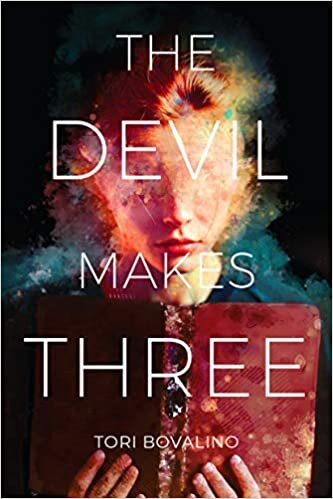
Today’s guest for the SHIT is Tori Bovalino who holds a BA in English and anthropology from the University of Pittsburgh and an MA in Creative Writing from Royal Holloway, University of London. She is currently a student in Royal Holloway's Creative writing and practice-based PhD program. Her debut novel, The Devil Makes Three, releases August 10, 2021.
How much did you know about the submission process before you were out on subs yourself?
I knew a lot, but not enough! That’s probably a common answer for sub. My biggest thing, as a chronic Googler, was that I couldn’t find answers to very specific situations or statistics. I read so much of the SHIT series while I was preparing to go on submission to prepare for every eventuality.
Theoretically, I was prepared for the process: sending out to editors, waiting for responses, searching for meaning in rejections – because it’s a lot like querying. I don’t think I was emotionally prepared, and I wasn’t nearly as patient the first time around as I should’ve been!
My submission process on the first go was unlike many stories I read about in one big way: we didn’t sell the first book. I’d read accounts of people selling their second or third book, but when they were telling it, they’d already been past that part and onto that yes, that book that sold. When it didn’t happen for me, it honestly was pretty depressing – but the only option was to write something else.
Did anything about the process surprise you?
This perhaps will not be a surprise to other people, but especially the first time around, I was shocked by how many good books don’t sell. To be clear, I’m not saying this about myself or my first book! Mermaid book has a lot of flaws that I might sort through later, or I might not.
But when I was on sub, I exchanged with a lot of authors and read their books and there is so much incredible talent out there. One book in particular had been on sub for a long time, long enough that the agent had started telling the author that it might be time to take it off sub, and suddenly in the span of a few days it sells in a big deal and is now highly anticipated. The subjectivity. A few incredible authors I know didn’t sell their first few books and then, in the span of a year, sold multiple. You might read this and think, I know that person, and we could all be thinking of different people because these situations are so common. It’s honestly amazing how publishing will pass on an incredible book for the most ridiculous reason (again, not my first book, because that was not an incredible book).
There are a million reasons a book does or doesn’t sell, and very few of them have anything to do with the author.
Did you research the editors you knew had your ms? Do you recommend doing that?
The first time around, I didn’t. I didn’t specifically know the editors for the first book, so I just endlessly Googled imprints. That ended up okay, since it was just sort of faceless rejections.
The second time on sub was a year later, after I’d had a ton of time to research. I had a few editors I specifically liked so I requested we sent to them. The research beforehand, which was a lot of residual searching while I was on submission with Book 1, got me familiar with imprints and what I liked, which I did find helpful.
Personally, I’d recommend doing all of your research before sending the book on submission. My spiraling research while on submission literally changed nothing. But if you have an editor you think you’d connect with because of some MSWL thing/vague tweet/conference meeting, there’s no harm in suggesting them to your agent. But this is also the relationship I have with my agents: I trust them completely, but they know I like to have input on things and they can gently talk me down when I have bad ideas.
What was the average amount of time it took to hear back from editors?
It definitely varied! My first time on sub (the one I’ve referred to as Mermaids), I think we went out in late May, so right before summer hit. We didn’t hear back on a lot until September/October, with the last bit coming in February/March of the next year. I’m pretty sure the earliest rejection on that book came six weeks after sending it out.
For DEVIL, we went on submission in June (okay, maybe we just like going on sub in summer). Interestingly, the first rejection was like two weeks later. I had an R&R in August that ultimately didn’t work out. We heard back from most of the first round by September and launched off the second round then and had a few rejections before a ~positive~ email in December from my editor! Overall, I’d say my average to hear back was 8 weeks.
What do you think is the best way for an author out on submission to deal with the anxiety?
Cliché answer: write another book. Not just for distraction, but for two practical reasons: 1. As in my case, if the first book doesn’t sell, you have something else already working. I wrote THE DEVIL MAKES THREE while on submission with my first unsold book and it was such a sweeping relief to have something else to think about, stew on, worry about, and talk to my agents about. It was also proof to myself that I wasn’t this one trick pony, that I could create something else. And 2. If that first book does sell and is a standalone, you’ll probably eventually need a second book. If you haven’t heard of second book syndrome, it’s basically this thing where writing Book 2 is difficult because of added stress/pressure/expectations/anxiety. Having a second book that you wrote while not on deadline can ease up pressure immensely.
Besides writing, I strongly suggest finding a group of people who are also on sub to commiserate with. I had a wonderful group of five other writers to yell to and celebrate with. For your base sub group, I recommend keeping it small-ish. Some of my worst moments were discussed here, and it’s nice knowing those five people witnessed my meltdowns rather than a group of 35.
Finally, I thought failure stories were really helpful (but I might just suck). Stories of people not selling their first book and succeeding later took a lot of the pressure off. Not all of us will have six figure sales after a week on sub. If you do, excellent. If not, it’s okay. We’re okay.
If you had any rejections, how did you deal with that emotionally? How did this kind of rejection compare to query rejections?
Thick skin is great and all, but sometimes there’s nothing like a good cry. We all have our dream editors. To a certain extent, it’s unavoidable. There are definitely imprints that feel so, so right for you – and then, one person makes the call, and they don’t buy your book. Sucks, huh?
Rejections for THE DEVIL MAKES THREE varied! For Mermaids, the responses were usually lukewarm positive: “I liked the writing but the romance was meh,” “Loved the setting, not sure about the magic,” etc.. For DEVIL, it seemed that people either loved or hated it. It was a weird experience for me. To be fair, the book starts slow, and the third person narration is stylized in a specific way. It’s not a book for everyone and I get that. I knew it when I was writing it.
I did find a cathartic exercise to laugh about rejections. Have you seen those “selected praise” marketing images? Where there’s the book and then highlighted blurbs or reviews? I picked the worst line from each rejection and made one of those for the book. It helped me laugh about the whole experience. Yelling with close friends helped too, as always.

I thought rejections on sub were both easier and harder than query rejections. On one hand, my agents were on my side to say, “This sucks, but it’s okay. We’ll keep going.” On the other hand, you feel so close. There’s that saying, “It only takes one yes,” which is only half true. But you feel like you’re one yes away, and that yes just isn’t coming, and surely that means it’s your fault? But perhaps this book just isn’t your greatest work, even if you can’t see it yet, or maybe now is just not the time. The biggest difference I found with querying and being on sub was that with querying, when I got rejected, I could just fire off another query. On sub, you sometimes have to sit with that rejection a little longer.
If you got feedback on a rejection, how did you process it? How do you compare processing an editor’s feedback as compared to a beta reader’s?
Editorial feedback from absolutely everyone has one thing in common: it’s subjective. You have to choose the subjective view that most aligns with your own. On submission, as rejections roll in, it’s helpful to search for patterns. For example, in Mermaids, a few of the rejections specifically addressed the romance in the book. Therefore, it was time to fix the romance. DEVIL didn’t have a lot of cohesiveness in rejections: one for voice, one for concept, one for character development, so on and so forth.
I had some really excellent beta reader feedback on projects and some editorial feedback on submission that made me go, “hmm, I don’t think they get what I’m trying to do.” But if they don’t get what I’m trying to do, either our visions don’t align, or I’m not doing That Thing effectively. So even the feedback that makes me scratch my head shows that there’s some weakness in the manuscript.
When you got your YES! how did that feel? How did you find out – email, telephone, smoke signal?
Smoke signal, obvs. But really, it was kind of awesome? I just had this very odd feeling in December that Something Might Happen. My family was in London with me for my graduation and we went to see Wicked. Halfway through “Defying Gravity,” one of my agents texted me that Lauren from Page Street emailed, asking for a call in January. I did not scream until intermission, which was good for everyone else in the theater, I suppose. At intermission, I told my mom that maybe someone was interested?????
The wait until January was intense, but I just had to keep reminding myself that it very well could be an R&R. It happens! On the day of, I got off work and walked from Soho to King’s Cross so I wouldn’t jump out of my skin in my apartment, and I called my friend to just yell for an hour. I got home and hopped on the call and I was SO NERVOUS, but it was all fine and I’m pretty sure I didn’t do anything embarrassing (maybe). Lauren offered and it was wonderful and then I drank an entire bottle of prosecco out of a pint glass alone in bed, because that’s what happens when you’re an adult who lives alone and abroad.
It was honestly surreal, which is probably why I didn’t tell many people before it was announced. It’s funny – on the announcement day, I just felt like, “HA! You can’t take it back now!!” as if I’d duped Lauren and she hadn’t literally read and loved my book. It didn’t feel real real until I had pass pages, to be honest. Like at any moment someone was going to call me and say, “Well, actually, we’ve reconsidered.” I wonder if that feeling will ever really go away!
Did you have to wait a period of time before sharing your big news, because of details being ironed out? Was that difficult?
It was actually pretty quick! We had the offer in January and announced in February, so I didn’t have to wait as long as most people. I actually hadn’t told many of my friends or family before the announcement came out simply because I was waiting for time to Skype/call (I live abroad; it can be tricky to arrange) and then suddenly, BAM! Announcement! To be fair, I think it was a bit easier in my case because we had word from my editor in December that she wanted a call, so we had a whole month to think about it. By the time the offer came around, my agents and I had talked about what I wanted and I had a month to think about contracts.


