SJ Laidlaw On Using Real-Life Experience As Inspiration

25893705.jpg

Inspiration is a funny thing. It can come to us like a lightning bolt, through the lyrics of a song, or in the fog of a dream. Ask any writer where their stories come from and you’ll get a myriad of answers, and in that vein I created the WHAT (What the Hell Are you Thinking?) interview. Always including in the WHAT is one random question to really dig down into the interviewees mind, and probably supply some illumination into my own as well.

Today's volunteer for the WHAT is SJ Laidlaw, author of FIFTEEN LANES.

Ideas for our books can come from just about anywhere, and sometimes even we can’t pinpoint exactly how or why. Did you have a specific origin point for your book?

I moved from Indonesia to India in the winter of 2012. At the time I was working on a book set in Indonesia but I started volunteering with a couple of NGOs in the red-light district in Mumbai, trying to help sex workers and their children. The goal was to prevent second generation trafficking. The vast majority of sex workers in India are trafficked. It's estimated that as many as 90% of their daughters end up in the sex trade, if they don't get support from NGOs to help them escape. As a social worker, I’ve had training to work with survivors of sexual violence, so I thought perhaps I could put my training to use.

While working with these NGOs, I was approached by a strategic philanthropy organization that was producing a countrywide report on sex trafficking in India. They asked me to edit their report and write the executive summary. This involved reading all of their primary sources, as well as everything I could find on sex trafficking. As I became immersed in the struggles of children growing up in brothels, my interest in my Indonesian story waned. I realized I needed to write about the lives of the children I was working with.

Kamathipura, the red-light district of Mumbai, is intensely populated but spread across a small area of just fifteen lanes. For sex workers and their children, it’s often their entire world. Poverty and rejection by the rest of society inhibits them from venturing outside their community. To capture the narrowness and isolation this community feels, I titled the book FIFTEEN LANES. The black lines that trap the bird on the cover are an actual map of the neighborhood.

Once the original concept existed, how did you build a plot around it? 

While the lives of the girls I was working with were filled with dangers and depravations, the girls themselves were amazingly positive. They don’t see themselves as victims. In fact, having spent many years working with kids in international schools, I was struck by how determined and optimistic these kids were compared to some of the kids that I’d counseled in international schools. It got me thinking about how suffering is difficult to quantify and even harder to predict. 

Having rich, loving parents doesn’t necessarily protect a kid from pain. Growing up in a brothel doesn’t necessarily mean you’re not going to feel loved and supported. A lot of how we respond to adversity depends on the resilience that we’ve developed through confronting hardship. Most of the girls I worked with in Kamathipura were incredibly strong and often mature beyond their years, particularly if they had younger siblings. They were often tasked with raising their siblings and were very protective of them. 

I decided to write a story that shows how suffering and sexual violence cut across class and culture. It's told in the voices of two girls. Noor is the daughter of a sex worker. She and her younger siblings live in a brothel in Kamathipura. Grace is the daughter of an international banker who has lived the nomadic life of a Third Culture Kid. While Grace is from a wealthy and privileged background, both girls experience adversity in different ways.

Noor’s story was partly content driven. I needed to introduce a very foreign world, not only India, or the life of underprivileged children, but the life of a girl who is raised in a Mumbai brothel. The girls I was working with faced so many challenges, from the day-to-day reality of poverty, prejudice and disease, to the near-constant exposure to sexual violence.

Because I wanted to give as complete a picture of Noor’s world as possible, I decided to start with her earliest awakening to her circumstances. Her narrative starts when she’s five-years-old and continues until she’s seventeen. 

Grace’s narrative was easier to craft as it’s one that readers will be familiar with and one I’m more familiar with myself. While I worked in Kamathipura for over two years and was working with sex workers’ daughters while I wrote the book, I’ve worked with girls like Grace for many years. She’s a fragile, socially isolated girl who becomes the target of extreme bullying. Her narrative spans just a few weeks.

Aside from the different timelines, the main challenge in writing this book was juxtaposing Grace’s suffering with Noor’s and not letting one story overwhelm the other. 

Have you ever had the plot firmly in place, only to find it changing as the story moved from your mind to paper?

This story never changed much from my original direction, though I had to do several major rewrites to tone down the graphic nature of the subject matter. I hope I’ve accomplished that but it still may be too much for some readers, particularly if they’re triggered by issues of sexual violence or self-harm.

That said, I’m writing about the lives of two girls who are both victimized in real and terrifying ways. It’s a hopeful story but not a light-hearted read.

Do story ideas come to you often, or is fresh material hard to come by?

Stories come to me easily. I have a lot of ideas. The challenge for me is that I get caught up with life. It’s not always easy to discipline myself to sit down at my computer. I’m trained as a social worker and adolescent counselor and I love that work, so it competes when I also want to write.

How do you choose which story to write next, if you’ve got more than one percolating?

Sometimes I think the stories choose me. I was on vacation in Nepal about nine months ago and by chance got talking to some Tibetan refugees. There’s a huge refugee community in Nepal, as it’s immediately across the border from Tibet. Like most people in the west, I knew about the Chinese occupation of Tibet, the exile of the Dalai Lama and of course the murder of Kelsang Namtso that was caught on video, but I didn’t know much more than that. The stories these refugees told me really moved me. I guess like many writers I need to connect with a story emotionally before I have the impetus to write it. I’ve begun working on a book about Tibetans.

When it comes to naming characters, I just rest my hands and let them tell me what their names are. What’s your process? 

It depends on the story but in the case of FIFTEEN LANES the names of the two main characters was deliberate. Both character’s names foreshadow their journey. 

With Grace, I thought a lot about the nature of shame. It’s terrible for any kid to be bullied or socially isolated but in counseling I found that kids felt so much worse if they believed they’d somehow provoked the bullying. We, as adults, understand that there’s never a legitimate reason for bullying but it can be hard to convince a kid of that.

Grace’s feeling of shame significantly intensifies her misery. It also makes it hard for her to ask for help, particularly from her mother who she feels she’s disappointed. So, in her case, I was thinking about the concept of sin or falling from grace.

Noor’s name means “light,” or “of the light.” I’ll leave my readers to decide if that was a good name choice.
Emily Ross On Inspiration

Inspiration is a funny thing. It can come to us like a lightning bolt, through the lyrics of a song, or in the fog of a dream. Ask any writer where their stories come from and you’ll get a myriad of answers, and in that vein I created the WHAT (What the Hell Are you Thinking?) interview. Always including in the WHAT is one random question to really dig down into the interviewees mind, and probably supply some illumination into my own as well.

25694706.jpg

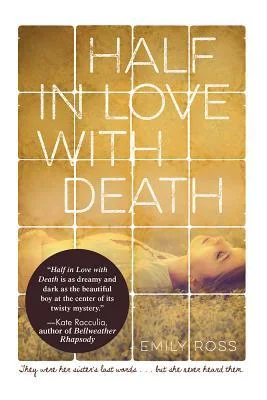
Today's guest for the WHAT is Emily Ross, author of HALF IN LOVE WITH DEATH, for which she received a 2014 Massachusetts Cultural Council finalist award in fiction. Her fiction and nonfiction have been published in Boston Magazine, Menda City Review, and The Smoking Poet. She is an editor and contributor at Dead Darlings, a website dedicated to discussing the craft of novel writing. She attended Sarah Lawrence College and the University of Massachusetts Boston, and is a 2012 graduate of Grub Street’s Novel Incubator program.

Ideas for our books can come from just about anywhere, and sometimes even we can’t pinpoint exactly how or why. Did you have a specific origin point for your book? 

Yes I do. I was having trouble plotting my novel when my sister suggested I turn to a true crime for inspiration and not just any crime. She confided in me that when she was 12 she’d been obsessed with the case of Charles Schmid, ‘the Pied Piper of Tucson.’ Schmid was a charismatic young man who murdered three teenage girls, and buried them in the Arizona desert. Two of his victims were sisters. I was surprised to be hearing about this crime that took place in the sixties, for the first time now from my own sister. I had to look deeper into this case.

I learned that Schmid had been very popular with Tucson teens and had lots of girlfriends. Some of the material about him read more like an episode of Gossip Girl, than the thoughts of a serial killer. Photos from an old Life Magazine article from 1966 showed him to be a handsome guy who didn’t look like a murderer. In fact he didn’t look all that different from kids I’d hung out with in high school. One of the many aspects of this case that disturbed me was that some of Schmid’s friends had known about the murders and didn’t tell anyone. I began thinking about how little I understood about my own friends as a teen, and how blindly I’d counted on love to solve everything. Slowly a story emerged about secrets, lies, and a girl who falls for someone who may not be what he seems.

Once the original concept existed, how did you build a plot around it? 

Researching this crime gave me a broad arc for my story and a sense of events that could happen. It also helped me to develop my main characters. I decided to tell the story from the point of view of a girl whose older sister goes missing, and based my protagonist loosely on Wendy Fritz, Schmid’s youngest victim. I was drawn to a photo I found of her. She looked so innocent and uncertain, and reminded me of myself at that age. Other than this photo though there was almost no information on her. Ultimately this turned out to be a good thing because it freed me to tell a story that was quite different from the case. But I didn’t leave my original concept entirely behind. I wove many details from the crime into my book, sometimes without even realizing it.

Have you ever had the plot firmly in place, only to find it changing as the story moved from your mind to paper? 

I usually don’t start with the plot firmly in place. I wish I did. Rather I have a vague idea of the major plot points and the ending, but things change a lot as I write a draft. I’m okay with that as long as I keep heading in the right general direction. But revising my novel was a painful process with lots of wrong turns. For my next novel I’d like to have the plot firmly in place before I start. We’ll see…

Do story ideas come to you often, or is fresh material hard to come by? 

A lot of vague story ideas float through my mind but they’re more like bits of a story, a line, an image, a voice. Sometimes when I write it feels like I'm making a collage out of all these little pieces of things. I have to figure out what connects them and how they fit together, but I usually don't start to see the connections until I’m well into a draft. Even then I stumble around in the dark hoping that a story will emerge from all the bits and pieces. The strange thing is that it often does.

How do you choose which story to write next, if you’ve got more than one percolating?

I’m pretty indecisive so choosing what to write next is hard for me. Right now I have two novel ideas bouncing around in my head. One is about a teenage girl who aspires to be a video game designer. It will require a lot of research, since I don’t even play video games. The other is about dance teams, something I’m a little more familiar with. To help myself decide I often just start writing to see if the idea holds my interest. If I find myself writing lots of pages, that’s usually the story I choose to write next. If that doesn’t work I have also been known to arbitrarily choose one of my ideas and force myself to stick with it for a while to see if I can make it work.

Sometimes the perfect word eludes me. If I can’t come up with it in the moment I usually write something in ALL CAPS like A GREAT WORD HERE and move on to catch it later in revision. Do you roll with the flow, or go find that word right away?

I’m a bit obsessive so I try to find the word right away. I look it up in an online thesaurus or Google things like word for [fill in vague phrase]. But I rarely find the perfect word that way so then I do my best to roll with flow (difficult as that is), and add a comment in my draft that says, COME BACK. Usually the word will come to me later when I’m in the shower or at the grocery store or in some other awkward situation that makes it difficult to write it down.

Madeline Dyer On Sources Of Inspiration

Inspiration is a funny thing. It can come to us like a lightning bolt, through the lyrics of a song, or in the fog of a dream. Ask any writer where their stories come from and you’ll get a myriad of answers, and in that vein I created the WHAT (What the Hell Are you Thinking?) interview. Always including in the WHAT is one random question to really dig down into the interviewees mind, and probably supply some illumination into my own as well.

Todays guest for the WHAT is Madeline Dyer, a fantasy and science fiction writer, who has a special love for all things dystopian, paranormal and ghostly. Her debut novel, UNTAMED, was published by Prizm Books in May 2015.

Ideas for our books can come from just about anywhere, and sometimes even we can’t pinpoint exactly how or why. Did you have a specific origin point for your book?

Normally, I can’t pinpoint exactly where my ideas come from—usually, they come from a mixture of things… but with UNTAMED I do have a specific origin point: the music video for ‘La La La’ by Naughty Boy featuring Sam Smith. More specifically, it was a scene in this video, where I saw what I interpreted as a human heart being sold at a market (whether it was actually a pig’s heart, I’m not sure) and I just thought what if people can buy emotions at an everyday market like that (as a human heart can represent love, passion, commitment, etc.)? And that’s where the idea came from really. Of course, it soon grew into something much, much bigger, as I combined it with research and imagination. 

Once the original concept existed, how did you build a plot around it?

So, once I had this premise worked out—that people would be able to buy the emotions they wanted to feel—I started thinking about characters. For me, characters always drive the plot, so once I’d created a handful of characters that I absolutely fell in love with, the plot came pretty fast. At this point, I started on the world-building, and decided I wanted a strong dystopian regime in place that tried to eradicate all negative emotions—at the expense of humanity. And I also wanted conflict. A lot of conflict. From then on, the plot just grew and grew, thanks to my characters and their actions. 

Have you ever had the plot firmly in place, only to find it changing as the story moved from your mind to paper?

Yes! This happens quite a lot. I’m just trying to think back to when I was writing the first draft of UNTAMED… there were quite a few plot points that changed dramatically when I went from my plan to the first draft. Mainly, these changes were caused by the characters not doing what I wanted. They all had different ideas, and a couple of them reacted totally different to how I expected, throwing the story off in a whole new direction. 

But most of my big changes occur when I’m going from the first draft to the second. Usually, by the time I’ve finished the first draft, I know the characters really well, and I’ve got loads of ideas about what needs changing. With UNTAMED, one of the major changes was who the love interest of my main character was going to be; another character just wasn’t happy about my plans at all—to the extent that the original love interest got written out in the second draft. 

And these changes happen all the time! I’m currently working on book two in the Untamed Series, FRAGMENTED, and I’ve just finished rewriting a massive section. It still leads to the same place, but uses different means to get there that are more appropriate to the characters and the story.

Do story ideas come to you often, or is fresh material hard to come by?

I always seem to have ideas! And I can’t type fast enough! 

I’m currently actively working on three different projects (the next two Untamed books, and a new dystopian novel for adults), and I’m feeling a bit overloaded by just how much motivation and inspiration I have. Sure, I have days where I can’t be bothered to write and the thought of sitting down with my laptop again fills me with dread—but at the same time, I want to write, I need to. And when I have, I feel a lot better. It’s addictive. 

How do you choose which story to write next, if you’ve got more than one percolating?

Ah, now this is something I still haven’t quite perfected. I always seem to be overrun with ideas, and tend to work on more than one story at a time—though, even then I always have one main one. Still, it gets a bit hectic, and I keep separate notebooks for each project so I don’t mix my ideas up. At the moment, I’m working on Untamed book two (as my main project), and then writing scenes and bits and pieces of Untamed book three, and my new work-in-progress.

I tend to just go with the story that I want to write that day. Unless I’m on a deadline! 

Sometimes the perfect word eludes me. If I can’t come up with it in the moment I usually write something in ALL CAPS like A GREAT WORD HERE and move on to catch it later in revision. Do you roll with the flow, or go find that word right away?

I do the ALL CAPS THING all the time! And you know what? I’m so glad I’m not the only one! I think that if I stopped every time I couldn’t find the perfect word, I’d definitely disrupt the flow of the story—particularly if it’s the first draft. And I’ve found I work best when I get the first draft down as quickly as possible. I completed draft one of UNTAMED in around 24 days, then spent the following 18 months fixing things, rewriting and revising, and working through edits with the lovely editor my publisher assigned me. 

So yeah, my first drafts tend to resemble a bit of a patchwork really. They’re filled with notes, comments, highlighted sections that need rewriting and lots of capitalized reminders. 

Anyway, the later drafts are for finding the perfect words, right? I usually don’t allow myself to start editing, changing words or doing major research (unless it’s absolutely necessary) until I’ve finished a draft for fear of disrupting the rhythm I’ve created.