Allan Wolf On The Urge To Create

Inspiration is a funny thing. It can come to us like a lightning bolt, through the lyrics of a song, or in the fog of a dream. Ask any writer where their stories come from and you’ll get a myriad of answers, and in that vein I created the WHAT (What the Hell Are you Thinking?) interview. Always including in the WHAT is one random question to really dig down into the interviewees mind, and probably supply some illumination into my own as well.
31247797.jpg

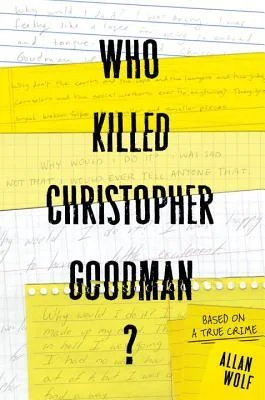
Today's guest for the WHAT is Allan Wolf, author of WHO KILLED CHRISTOPHER GOODMAN? which is based on a true crime. Allan is an educator-writer-musician extraordinaire. He has literally hundreds of poems committed to memory. He is a veteran traveler through all the diverse worlds of poetry--from poetry slams to public schools, salons to saloons. He turns classic poetry into acoustic tunes as the drummer for The Dead Poets band. He put the Oh! in poetry as the educational director for national touring company Poetry Alive!

Ideas for our books can come from just about anywhere, and sometimes even we can’t pinpoint exactly how or why. Did you have a specific origin point for your book?

Out of the gate, I should say that I am not a writer in the usual sense. I am more of a creator. I have an urge to create. Writing and poetry is my default medium. We all have these urges to create life from the clay of our imaginations. And in that respect we are all amateur gods. (I’ve been writing a rock opera for more than twenty years now. But I didn’t even know it was a rock opera until about a year ago!) My point is that “Book Ideas” are just observations in process. The seed of my novel, Who Killed Christopher Goodman?, was planted in me in 1979, the day I learned that my friend, Ed, had been murdered.

Once the original concept existed, how did you build a plot around it?

So I carried this confusion and grief around with me for years. How can a living person simply vanish from the world? Why wasn’t I able to stop it? I began meeting old high school buddies at the New River near Blacksburg, VA every August, which is the anniversary of Ed’s death.  I started a habit of shouting out Ed’s name during my first leap from the river’s diving rock. This went on for years before it occurred to me, out of the blue, that I could turn the memories into a book.

Have you ever had the plot firmly in place, only to find it changing as the story moved from your mind to paper?

The plot for Who Killed Christopher Goodman? started out “firm as a church” as they say. After all, the plot was based on a real event, and facts are facts.  But I found that the more I stuck to the facts, the more I failed to control the emotional pace of the novel. My personal feelings kept interfering with the needs of the story. I found myself fictionalizing the facts, changing names, altering timelines, and adding fabricated details in order to insulate myself from the pain of my personal connection.

Do story ideas come to you often, or is fresh material hard to come by?

Story ideas come to me quite easily. As a person who writes books, the perfect premise is always on my mind. Just like a painter is always evaluating what she sees through her painterly lens, so the writer does. Or the dancer. Or the sculptor. Even as a preteen skateboarder, I evaluated every remotely skate-worthy surface through the lens of a skateboarder. Once an artist identifies himself (whether by professional practice or personal habit) as “a writer,” he pretty much wears those lenses 24/7.

How do you choose which story to write next, if you’ve got more than one percolating?

I’m almost always working on multiple projects all at once. But this is largely due to the fact that I work in a variety of mediums. While researching a longer novel, I can always divert myself by writing poetry or song lyrics. That said, there comes a point where I have to put in my earplugs, tie my leg to the desk, and get the project done. No messing about. I’ll get a head of steam and everything else falls away.

I recently got stitches in my arm and was taking mental notes the entire time about how I felt before, during, and after the process of being badly injured. Do you have any major life events that you chronicled mentally to mine for possible writing purposes later?

In my journals, I have chronicled broken bones, childbirth, potty training, car wrecks, and a botched vasectomy that would make the most unflappable of nurses run screaming from the room.  It’s all in my journal. Who Killed Christopher Goodman? includes a run-in I once had with a lady police officer who threw me against her cruiser and checked me for weapons. The whole outrageous event happened pretty much exactly as I depict it in the book. I suppose everything that happens to a writer is just a dress rehearsal for the next novel, poem, picture book.

Stephanie Elliot On Loving (And Hating) Social Media

Inspiration is a funny thing. It can come to us like a lightning bolt, through the lyrics of a song, or in the fog of a dream. Ask any writer where their stories come from and you’ll get a myriad of answers, and in that vein I created the WHAT (What the Hell Are you Thinking?) interview. Always including in the WHAT is one random question to really dig down into the interviewees mind, and probably supply some illumination into my own as well.

34567484.jpg

Today's guest for the WHAT is Stephanie Elliot, author SAD PERFECT, which was inspired by her own daughter’s journey with ARFID, Avoidant/Restrictive Food Intake Disorder. She has written for a variety of websites and magazines and has been a passionate advocate of other authors by promoting their books on the Internet for years. She has been, or still is, all of the following: a book reviewer, an anonymous parenting columnist, a mommy blogger, an editor, a professional napper, a reformed Diet Coke drinker, a gecko breeder and the author of three self-published novels.

Ideas for our books can come from just about anywhere, and sometimes even we can’t pinpoint exactly how or why. Did you have a specific origin point for your book?

I didn’t really think, “Oh I’m going to write this book.” In fact I wasn’t even thinking of writing YA. I was in the middle of writing women’s fiction. My daughter had met a boy in a very interesting way, a sort of meet-cute, and I thought I would write a vignette about the way they met, maybe a quick one-page scene. And from there, I kept writing for three months.

Once the original concept existed, how did you build a plot around it?

Sad Perfect is loosely based on my daughter’s eating disorder, ARFID (Avoidant /Restrictive Food Intake Disorder), her therapy, and her recovery so that was the basis for the plot.

Have you ever had the plot firmly in place, only to find it changing as the story moved from your mind to paper?

Yes, but I don’t ever go in to a writing session expecting my plot to stay the same. I don’t plan to stick with everything I have in my mind—that would be pretty boring for me. Since I’m what they call a pantser, I go where the story takes me. It’s more fun that way, also a lot more surprising. 

Do story ideas come to you often, or is fresh material hard to come by?

I think of story ideas all of the time. The hardest part for me is sitting down to write them. I have four story ideas on paper and in my head right now that I could sit down and get working on. Am I sitting down and working on them? No. I’m on Twitter and Facebook and Instagram! I hate social media! I love social media!

How do you choose which story to write next, if you’ve got more than one percolating?

I either talk with my agent (who is also YOUR agent and a wonderful sounding board!), or I work on the one that I have fleshed out in my mind the best. Which is usually the one where the most characters are talking to me. 

I usually have a cat or two with me while I write. They’re good for a pet if I need a moment away from the screen, and don’t seem to mind if I ignore them completely as long as I’m sharing body heat. Do you have a writing companion? 

Facebook and Twitter, but I hate them! LOL! But seriously though, The Swanky Seventeens debut writing group has been a lifesaver in this journey. The authors are so supportive and motivating when I need someone to get me moving on my work in progress, or when I’m feeling down about something. They are my current companions in this crazy journey! But lucky for them, I don’t ask to pet any of them!

Brian David Johnson On Storytelling And Knowing What To Cut

Inspiration is a funny thing. It can come to us like a lightning bolt, through the lyrics of a song, or in the fog of a dream. Ask any writer where their stories come from and you’ll get a myriad of answers, and in that vein I created the WHAT (What the Hell Are you Thinking?) interview. Always including in the WHAT is one random question to really dig down into the interviewees mind, and probably supply some illumination into my own as well.

29915052.jpg

Brian David Johnson is the co-author of MWD: HELL IS COMING HOME, a graphic novel about Liz, a young soldier who returns from Iraq suffering from PTSD, and the two dogs that help her cope; Ender, the military working dog who saved her life, and Brutus, a stray she connects with after her boyfriend nearly hits him with her car.

Ideas for our books can come from just about anywhere, and sometimes even we can’t pinpoint exactly how or why. Did you have a specific origin point for your book?

I don’t believe there was a specific origin point for MWD in terms of an “a-ha” moment.

My co-author Jan Egleson approached me with the idea of writing about a returning female soldier from Iraq, who was also a dog handler. He also felt strongly that she was suffering from PTSD and the dog would be central to her healing. Therefore, her primary struggle was going to be getting her dog back from the army.

Jan is an artist who has explored PTSD several times in his career as a theater/film director and author. In the mid 70’s, he produced and directed a play called “Medal of Honor RAG,” with the Theater Company of Boston, that play was also televised in 1982. In addition, he wrote a book called “Zero,” which focused on his father’s experiences in the Pacific Theater in WWII.  He is also the father of two daughters and has a dog named Max, so the idea flowed from that amalgam of experiences.  

For myself, the idea resonated because I was both a journalist who had covered soldiers returning home from war. In addition, I had a sister-in-law who worked with female veterans and another sister –in-law who works as a dog trainer. For me, the idea appealed on several levels.

Once the original concept existed, how did you build a plot around it?

For me, storytelling is a process of answering a series of questions, with the mission of narrowing a broad concept into a narrative that is compelling, logical and plausible. When we had an outline of an idea about a female veteran and her dog, we set about finding out as much as we could about her character. Why was she in the military? What did she experience while she was there? We repeated that step with the other characters that would appear in the book.

Following the character work, we had to construct a dramatic narrative, so we had to take what we knew about our character and decide how and what we would reveal her story in a way that showed the reader, rather than told them about how her experience in war would shape her homecoming. This involved a lot of construction of scenes using whiteboards and notecards, which we would arrange and rearrange accordingly. Note cards are the best way to frame a story because you can visualize the journey of your characters and easily arrange/rearrange. Several programs now allow you to do this digitally but we used note cards.

Have you ever had the plot firmly in place, only to find it changing as the story moved from your mind to paper?

Every story changes when you try to put it to paper because the mind works much faster than your hands can. I find that it’s best to try and flesh out the scene with very obvious dialogue that expresses what your characters are trying to convey and then re-write it as you go along to get more subtle and add more subtext.

Plot wise, MWD changed dramatically over its many iterations. First, it was a screenplay where our main character was older and had a child. As a result, we delved more into what mothers who come home from war face with their children. In addition, we had a much more complicated plot, that included a mystery, which was slow revealed over the course of several flashbacks.

As we modified the story, the main character became younger, we eliminated the child character and several other characters as well. In addition, we internalized several of the flashback scenes. By that, I mean that as writers we agreed that just because we didn’t place those scenes in the final draft it didn’t mean they didn’t happen. Instead, we would use those experiences to shape the way our character reacts to her surroundings. I think this enabled us to create a much more nuanced picture of PTSD without having to show everything that ever happened to our character.

In some ways, cutting almost 50-75 pages of scenes, characters and dialogue was really freeing as a writer. It also helped create a much more nuanced piece.

Do story ideas come to you often, or is fresh material hard to come by?

I come up with ideas constantly. The good ones tend to stick around my memory for a while and if that happens I will write them down in a notebook, or start a Scrivener file with that idea in it with the intention of one day returning to it. Ideas are not hard to come by, which means the art is in the discipline it takes to flesh out an idea to its fullest extent. Remember, any good book will take a minimum of six months to a year to write so those ideas have to really capture your attention.

How do you choose which story to write next, if you’ve got more than one percolating?

Even the great ideas, which I know I want to write one day, require some sort of inspiration to tackle. I have ideas that have been in my head for decades but I just don’t feel like I have the skill or the patience to tackle them at the time, so the story has to choose me as well. Momentum is really important to me. I have to feel like I’m writing downhill or else I’ll get frustrated and stop. Writing for me is mood and discipline. I have to be in the mood to tackle a project and then the discipline to work on it every day until it’s done.

Technically, I will say that programs like Scrivener are really handy because you can easily build the spine of a story with their notecard feature and then store research materials and other things into the story file. I like to take pictures of things and find a lot of historical material to use as reference points so that’s helpful to keep in the same file. Filling the research file also helps you feel like you’re working even if you’re not working on the text. Also, project notes/writing exercises are all really helpful to kick start the process.

Interestingly, the first and final scenes of MWD were buried in a notebook that I had lost and then found when we were writing the final drafts. It was rather amazing to open this notebook and find that I had written these pivotal scenes as a throwaway writing exercise some five years earlier.  The lesson there is, keep your notes.

I recently got stitches in my arm and was taking mental notes the entire time about how I felt before, during, and after the process of being badly injured. Do you have any major life events that you chronicled mentally to mine for possible writing purposes later?

I’m not much of an autobiographical writer but I will frequently incorporate my own experiences into my stories. For example, I was at the beach and a young woman starting drowning right in front of me. I swam in and, along with another man, was able to help her until the lifeguards arrived. As I was trying to help her I could feel myself starting to tire really fast and I had to let go of her for a moment to try and not drown myself. When we finally got her rescued I felt very guilty about that one moment where she thought I was abandoning her. That night I wrote into the book I was writing a drowning scene and explored those feelings of guilt.