Hayley Long & The Negative Voice In Your Head

I'm lucky (or cunning) enough to have lured yet another successful writer over to my blog for an SAT- Successful Author Talk. SAT authors have conquered the query, slain the synopsis and attained the pinnacle of published. How'd they do it? Let's ask 'em!

25382680.jpg

Today's guest for the SAT (Successful Author Talk) is Hayley Long, author of several award-winning books for teenagers, including What’s Up with Jody Barton? and the Lottie Biggs books. She also works as an English teacher. Her newest release is SOPHIE SOMEONE releasing March 28th from Candlewick Press. Hayley Long lives in England.

Are you a Planner or Pantster?

Total pantster. I am also a total hypocrite because when I was an English teacher, I used to tell the kids in my classes that IT’S REALLY IMPORTANT TO PLAN. But the truth is, I just can’t do it! I begin with a very vague outline of a story in my head. I know where I will start, I have a rough idea of how I will end, and I have a few thoughts about what is going to happen along the way. And from there I just make it all up! It’s worked for me so far. All the best ideas I have had are ones which have occurred during the writing process – they’re not ones that I could ever have planned or predicted.

How long does it typically take you to write a novel, start to finish?

It varies. The fastest I’ve ever written the first readable draft of a novel has been six months – but it was still longer than that really because I was thinking about it for at least four months before I got going. SOPHIE SOMEONE is the book which took me the longest to write. Because it was the hardest to write. Making up my own coded language was harder than I anticipated. It took a lot of adjusting and readjusting. From start to finish, it was about two years before I had a draft which I was happy for anyone else to read.

Do you work on one project at a time, or are you a multi tasker?

Inevitably, I’ve found that I have to be a multi-tasker to a certain extent because there are always other things that need to be done. In between writing fiction, I visit schools and libraries, I sometimes write articles for newspapers or websites, and other times - like now - I answer questions. But I find it impossible to concentrate on two big writing projects at a time. I can’t switch my mind from one major puzzle to another. So if I’m writing one thing and asked to do edits for another, I have to put the new writing on hold until I’m free to give it my full attention again.

Did you have to overcome any fears that first time you sat down to write?

Gosh YES. But I STILL DO.  Every time I start a new book, I go through this same old rigmarole. There’s this voice in my head which is saying, ‘Hayley, what are you doing? This won’t work. Nobody is going to like it. And you need to write about three hundred pages and you’re only on page four. This is a waste of time. GIVE UP NOW.’

That’s what the inside of my head is like every single time I start a new book. And sometimes it stays like that until I’ve had feedback from my agent and editor!

At least, there’s no danger of me getting over-confident and carried away with myself.

How many trunked books did you have before you were agented?

None. It wasn’t like that for me because I was having books published before I had an agent. I lived in Wales and I had two novels published with a small Welsh publishing house. By the time I was ready to look for an agent, my Welsh publishing friends were suggesting names of agents who I might try. I sent my manuscript of Lottie Biggs is not Mad to the first name on the list and I received a positive reply.

Have you ever quit on an ms, and how did you know it was time?

Oh yes. But I always quit early on - before I even have 10,000 words. And then I delete all memories of it from my head.

I know I have to quit when I’m struggling to write more than five words an hour.

How did it feel the first time you saw your book for sale?

Oh, it was totally lush. I think I hung out around the shelf for a while.

How much input do you have on cover art?

Honestly? Not a lot. But I’m not a designer or a marketing expert so I’m very happy for others to take the lead. The production of a book is not just about me – it’s a team effort.

I’m always shown the cover ideas and asked whether I like them or I don’t. I’ve only strongly objected once and that was because the message communicated by that cover really worried me. On every other occasion, I’ve liked my covers. While we’re on the subject, I think the cover of SOPHIE SOMEONE is very stylish. I like the way the artwork is a subtle nod to Brussels and London.

What's something you learned from the process that surprised you?

It’s not really surprising - but the suggestions of editors are almost always right. They see things that the writer doesn’t. And sometimes it amazes me how a seemingly simple suggestion from an editor can have such an enormously positive impact on my novel. It’s nice because it has the overall effect of making  me seem cleverer than I am ☺

How much of your own marketing do you?  

I have a website. It’s not very flashy but I built it all myself which is nothing short of extraordinary because I have extremely limited skills! And I’m on Facebook.

And that’s it. Social media? Less is more ;) 
Allan Wolf On The Urge To Create

Inspiration is a funny thing. It can come to us like a lightning bolt, through the lyrics of a song, or in the fog of a dream. Ask any writer where their stories come from and you’ll get a myriad of answers, and in that vein I created the WHAT (What the Hell Are you Thinking?) interview. Always including in the WHAT is one random question to really dig down into the interviewees mind, and probably supply some illumination into my own as well.

31247797.jpg

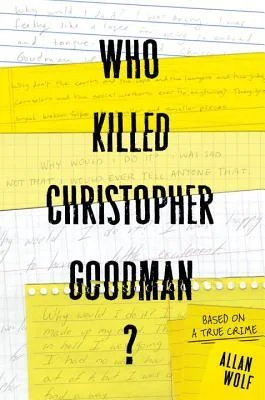
Today's guest for the WHAT is Allan Wolf, author of WHO KILLED CHRISTOPHER GOODMAN? which is based on a true crime. Allan is an educator-writer-musician extraordinaire. He has literally hundreds of poems committed to memory. He is a veteran traveler through all the diverse worlds of poetry--from poetry slams to public schools, salons to saloons. He turns classic poetry into acoustic tunes as the drummer for The Dead Poets band. He put the Oh! in poetry as the educational director for national touring company Poetry Alive!

Ideas for our books can come from just about anywhere, and sometimes even we can’t pinpoint exactly how or why. Did you have a specific origin point for your book?

Out of the gate, I should say that I am not a writer in the usual sense. I am more of a creator. I have an urge to create. Writing and poetry is my default medium. We all have these urges to create life from the clay of our imaginations. And in that respect we are all amateur gods. (I’ve been writing a rock opera for more than twenty years now. But I didn’t even know it was a rock opera until about a year ago!) My point is that “Book Ideas” are just observations in process. The seed of my novel, Who Killed Christopher Goodman?, was planted in me in 1979, the day I learned that my friend, Ed, had been murdered.

Once the original concept existed, how did you build a plot around it?

So I carried this confusion and grief around with me for years. How can a living person simply vanish from the world? Why wasn’t I able to stop it? I began meeting old high school buddies at the New River near Blacksburg, VA every August, which is the anniversary of Ed’s death.  I started a habit of shouting out Ed’s name during my first leap from the river’s diving rock. This went on for years before it occurred to me, out of the blue, that I could turn the memories into a book.

Have you ever had the plot firmly in place, only to find it changing as the story moved from your mind to paper?

The plot for Who Killed Christopher Goodman? started out “firm as a church” as they say. After all, the plot was based on a real event, and facts are facts.  But I found that the more I stuck to the facts, the more I failed to control the emotional pace of the novel. My personal feelings kept interfering with the needs of the story. I found myself fictionalizing the facts, changing names, altering timelines, and adding fabricated details in order to insulate myself from the pain of my personal connection.

Do story ideas come to you often, or is fresh material hard to come by?

Story ideas come to me quite easily. As a person who writes books, the perfect premise is always on my mind. Just like a painter is always evaluating what she sees through her painterly lens, so the writer does. Or the dancer. Or the sculptor. Even as a preteen skateboarder, I evaluated every remotely skate-worthy surface through the lens of a skateboarder. Once an artist identifies himself (whether by professional practice or personal habit) as “a writer,” he pretty much wears those lenses 24/7.

How do you choose which story to write next, if you’ve got more than one percolating?

I’m almost always working on multiple projects all at once. But this is largely due to the fact that I work in a variety of mediums. While researching a longer novel, I can always divert myself by writing poetry or song lyrics. That said, there comes a point where I have to put in my earplugs, tie my leg to the desk, and get the project done. No messing about. I’ll get a head of steam and everything else falls away.

I recently got stitches in my arm and was taking mental notes the entire time about how I felt before, during, and after the process of being badly injured. Do you have any major life events that you chronicled mentally to mine for possible writing purposes later?

In my journals, I have chronicled broken bones, childbirth, potty training, car wrecks, and a botched vasectomy that would make the most unflappable of nurses run screaming from the room.  It’s all in my journal. Who Killed Christopher Goodman? includes a run-in I once had with a lady police officer who threw me against her cruiser and checked me for weapons. The whole outrageous event happened pretty much exactly as I depict it in the book. I suppose everything that happens to a writer is just a dress rehearsal for the next novel, poem, picture book.

Organizer Tips for Author Visits

Organizers for events almost always ask me what my needs and wants are prior to arrival. I'm a very low-maintenance person, so it's pretty easy to answer. There are a few things that I've noticed over the years that are nearly universal across authors, so I've put together a few tips for event organizers on the most imperative things authors need the second we walk in the door.

Just remember this mythical animal - the BatCow.

Bathroom. Coffee. Water.

In most cases authors have just driven - or flown - in from places unknown in order to show for the event. It's pretty typical for a welcoming committee to spot us at the door, and immediately tell us how glad they are to see us, how much they loved our books, and if they can help carry anything.

All these things are really, really cool.

But usually the author really, really has to pee.

Point us to the bathroom before you tell us how much you love our books. Trust me, we all love compliments, but it's hard for us to respond to you with the appropriate amount of thankfulness when we're concentrating on not wetting down our legs.

The second thing I've noticed is that there is almost never enough coffee at events like festivals or gatherings with more than one author. Organizers seem to underestimate how much coffee authors are going to drink. The answer is a lot. We are going to drink a lot of coffee. Overload on the caff (not the de-caff) and I promise you there will be little to nothing left over.

Third - water. If we are on a panel, speaking to a group, or just hand-selling books from a table all day we are going to be talking - a lot. We need water. Bottled water with caps is best (take it from the girl who has spilled stuff all over her table - and books - more than once). If you're relying on jug dispensers and open containers there will be spills, and possibly, damaged books as a result.

These are the universal basics.

What else can you do? Plenty!

Parking can be a thing - especially if the author is appearing at a library and the spaces are taken by regular patrons as well as those attending the event. If authors bring their own books to events for sale, the nearer the entrance, the easier (and faster) setup will be. If you're able, assign a spot for the author near the entrance.

I've had schools use chalk to mark my spot, and libraries put a sign up to let patrons know not to park there. Either way is great (and I've never requested it, to be pleasantly surprised when it's provided). Definitely let the author know you've done this, though. We won't look for a special spot for us if we don't know it's there.

Tech is of the utmost importance. I've had a couple of visits where we were scrambling for tech to make things work before go-time. It's fine, things happen. But good communication before hand (and this applies to the author, too) can keep this from occurring. Ask your presenter if they need a projector, a screen, a mike, or if they have audio in their presentation. Also, be aware that a lot of authors are relying on flipping through slides with a remote during their presentation. Will the laptop be in the back, or the front of the room? Will the remote signal go that far? Stuff like that can be handled on the fly, but be aware of it beforehand so you can plan.

Book sales can help pad the author's takeaway from the visit, so always ask if they are willing to sign and sell. Some authors will request that you have a book seller available to handle sales, others have gone through the process of getting a vendor's license through their state so that they can handle sales themselves. 

Then - make sure it happens.

I've found Indie bookstores to be much more reliable when it comes to author visits, so ask a local bookseller if they'll do offsite sales before going to a big box store. If you do contact a bigger store, check, double-check, and check again to make sure they're going to be there. Once I had a bookseller no-show because there were too many people involved in the communication line, and things were dropped. Indies can be more dependable, but again - always double check that they are planning on being there a few days before the event.

If you are hosting a large festival or event, be absolutely sure that the bookstore has the books for every author who will be there. More than once I've been at events where an author has fallen through the cracks. Big festivals and fairs are a huge amount of work for the organizers, and things happen. 

But authors travel to most events on their own dime, and if they show up to discover that the bookseller has everyone's books but theirs... well, it's more or less a waste of their time - and money. Yes, we can still do a panel, answer questions, and pass out bookmarks. And chances are, most authors are going to do so with grace (there's not point upsetting librarians, organizers, and booksellers). But inside, trust me, they are not happy.

How to stop this from happening? Check. Re-check. Check again. Go down the list of books with the bookseller by author - and title - to ensure that books have been ordered for every author appearing.

Last thing when it comes to a bookseller providing the books - be sure if the author is promoting a series that you have ALL the available titles in that series. The author isn't going to have much luck hawking the third in a trilogy if s/he doesn't have the first and second ones on hand as well.

If the author is bringing books themselves have either people or a cart available to help move them inside the building - and don't freak out when you see how many boxes we have. Don't worry, we know we're not going to sell them all. I personally bring way more than I expect to sell. Better to have them and not need them than need them and not have them.

Lots of things to remember, I know. But there are just as many responsibilities on the authors as well - and I'll talk about those next week.