Bethany Crandell On Moving A Teenage Crush Into Publishing for Adults

Inspiration is a funny thing. It can come to us like a lightning bolt, through the lyrics of a song, or in the fog of a dream. Ask any writer where their stories come from and you’ll get a myriad of answers, and in that vein I created the WHAT (What the Hell Are you Thinking?) interview. Always including in the WHAT is one random question to really dig down into the interviewees mind, and probably supply some illumination into my own as well.

Today’s guest for the WHAT is a long-time friend of mine, Bethany Crandell, author of the young adult novel, SUMMER ON THE SHORT BUS, lives in San Diego with her husband, teenage daughters, and two destructive puppies. THE JAKE RYAN COMPLEX is her first adult novel, though still carries the heart and humor of teenage exuberance. For more information, visit Bethany online at www.bethanycrandell.com, Facebook, Instagram, & Twitter @bethanycrandell.

Ideas for our books can come from just about anywhere, and sometimes even we can’t pinpoint exactly how or why. Did you have a specific origin point for your book?

Pfft… No sleuthing required! Jake Ryan, from Sixteen Candles, is the reason this story came to be. I’m not sure if it was his sexy lip bite, the way he wore plaid, or the fact that he was secretly pining after the plain girl with smallish t*ts when he had the beauty queen on his arm, but something about that character stole my heart at a very early age. And since writing this book, I’ve come to find I’m not alone in that sentiment.

It seems that a lot of us Gen Xers still hang onto those toe-tingling feelings that we got as kids when we first met our fictional dream man. And if it wasn’t Jake than it was someone else: Duckie (Some Kind of Wonderful), Ren McCormack (Footloose), Sodapop Curtis (The Outsiders)… No matter who your guy was, he left a mark on your heart. And it’s those same feelings of nostalgia and excitement you still get (even when you’re forty-five and married for twenty years) when you see a picture of your guy that made me want to write this book. 

I mean…just look at him! 

Once the original concept existed, how did you build a plot around it?

I’d been writing young adult books for a decade and toying with the idea of a Sixteen Candles-inspired book for just as long. I knew I wanted to pay tribute to the original storyline—simple girl seeks boy of her dreams, tied-up in family/wedding drama—while still tapping into that glorious 80s nostalgia, but wasn’t sure how to pull that off in a young adult world since many of those readers might not know who Jake Ryan is. (My heart weeps for them!)  Then it dawned on me: write the book for people who know who he is. DUH! So that’s what I did. I took a leap and decided to write a book for the countless women born somewhere between 1965-1985 who fell in love with this character and would appreciate reading about another woman who did too. Once I allowed myself that freedom, the rest of the story just seemed to fall into place. It’s funny how our muses respond when we let them tell a story the way they want!

Crandell.png

Have you ever had the plot firmly in place, only to find it changing as the story moved from your mind to paper?

My overarching plots are generally cemented into place, but the nuances of the characters and the sub-plots are what constantly catch me by surprise. For the most part, I’m okay with that—it keeps me guessing and surprised while I’m writing—but there are days when it’s really frustrating.

Do story ideas come to you often, or is fresh material hard to come by?

My brain is literally a dumping ground for ideas (about 2% of them good), and is the most active while I’m under the hairdryer. Because I spend a lot of time blowing my hair (I’ve got a LOT of hair. Mindy can vouch for this. She’s seen the beast in person) my muse has learned to take advantage of the idle time by playing and sorting things out. Quite often it’s related to whatever book I’m working on (I call them “blow dryer epiphanies”) but a lot of my story ideas also germinate under the heat of my beloved Revlon 1875 ionic volumizing hair dryer.  (Available at Amazon for only $20.39. And yes, that’s a blatant plug to buy from my publisher. Ahem)

How do you choose which story to write next, if you’ve got more than one percolating?

Because I’m under contract, my editor’s enthusiasm for a project pretty much dictates what the next story will be, but I will only pitch her ideas that I’m really excited about. I’m not sure I could write something that didn’t get my engine revving.

I have 5 cats and one Dalmatian puppy (seriously, check my Instagram feed) and I usually have at least one or two snuggling with me when I write. Do you have a writing buddy, or do you find it distracting?

I’ve got two dogs and while they’re cute (when they’re not destroying the backyard) they are not good writing companions. One is very needy and cries a lot and the other is an obsessive kisser. If you so much as acknowledge his presence, you will get kissed. Apparently, my old age has turned me into a heartless curmudgeon because dog kisses on every part of my body sort of creep me out.


Exploring the Dystopian Genre

by Caitlin Lochner:

Who doesn’t love a good dystopia? I mean, reading about them, not living the current reality. It feels like not that long ago dystopias were all the books everyone was talking about—The Hunger Games, Divergent, Matched. I loved that heyday. But as with any trend, it eventually faded in popularity as new subgenres took its place. And yet, in the last few years, it feels like dystopia has been making a comeback—thank goodness for me!

There’s so much I love about this genre. I think especially in the current social and political circumstances, reading about main characters driven by the desire to create a better world appeals to me a lot. Who doesn’t want to cheer for someone seeking to overthrow a cruel and oppressive system? Who could resist being drawn into the immediate tension this large-scale conflict creates—not to mention the amazing possibility of tropes that can be tossed in? Complicated politics? Domino-effect consequences? Found families? Enemies to lovers? Sign me the HECK up.

But there are reasons the dystopian genre declined in popularity a while back. A big one is that readers got tired of seeing the same tropes over and over dressed up in slightly different names and circumstances. That doesn’t mean to avoid them! Tropes are great tools when used correctly. So if you’re a new writer in this genre, ask yourself: Am I putting my own unique spin on these classic dystopian tropes and conventions?

There are so many ways you can do this! For example, in my recently finished duology, A Soldier and a Liar, the two main characters aren’t on the side of the rebellion: The rebels are the antagonists. It’s a simple switch-up, but by putting the main characters on the inside of the corrupt government instead of on the side trying to destroy it, it offers a different perspective than we usually see in the genre. I feel like you can avoid a lot of pitfalls of almost any genre by asking yourself: How am I making this different? How can I give readers an experience that’s familiar but new?

There are plenty of other ways you can make your dystopia distinct, too! Something important to ask yourself is what your main character is fighting for. What is (s)he trying to accomplish or change? Why is (s)he personally invested in this fight? It can be hard to connect with a character who’s fighting just because it’s the right thing to do, because there’s no emotional investment or personal stakes. What’s at risk for this character if nothing changes? What about if (s)he loses this fight? Figuring out those personal conflicts and stakes early on can help make your character feel more three-dimensional, allowing the reader to be become more personally involved in the story as well.

Lochner.png

And then there’s my personal weakness: worldbuilding. With the world being such a huge part of the dystopian genre, it’s going to play a large role in the course of the plot and characters. If you already have a good idea of your character and what (s)he wants and stands for, you can ask yourself: What kind of world would be the worst for this character personally? Putting your main character’s core values at distinct odds with the world (s)he inhabits is a great way to build up to the eventual conflict that will arise in this world. But if you’re still figuring out your character, that’s okay! Sometimes the world comes first and we shape our characters within it. In these kinds of cases, it’s fun to ask hypothetical questions as sparks. For example, what if there was a world in which music was completely outlawed? Or where reading and education was a right reserved only for the most privileged 1% of society? Then, how does society exist around this basic principle—what’s different, what new laws and social norms would exist, what would the consequences be for breaking these laws/norms? The more specific and detailed a world you can create for your dystopia, the more memorable and interesting it will be for your readers!

Something I personally love about writing in this genre is exploring various characters’ answers on how to “fix” the problem of the oppressive ruling regime and blurring the lines of black and white morality. After all, tearing down a government and trying to establish a new one—fairly—involves a lot of messy work and hard choices. In A Soldier and a Liar, a lot of the characters have different views on how the problem of the discriminatory government should be righted. One character thinks you need to change it slowly from inside the system. Another starts a rebellion in an attempt to destroy everything. And yet another is part of a third party trying to create a peaceful movement that asks for normal citizens to take active action in their everyday lives. Each character makes mistakes in their endeavor for peace, but all their actions are fueled by the belief that what they’re doing is just. It’s a ton of fun to play with, especially whenever I got to blur the lines of what constitutes “good” and “evil” and explore to what extent the ends justify the means—something the main character personally grapples with frequently as she tries to figure out where to draw the line with doing bad things for good reasons.

There’s so much to love about the dystopian genre, and so many ways to turn this classic genre on its head. If you’re a new writer in this genre or feeling stuck: Remind yourself of what it is that draws you to dystopia and focus on those elements. Because at the end of the day, it’s important to embrace what we love in our own work.

Caitlin Lochner is a nerd, traveler, and architecture enthusiast who worked as an assistant English teacher in Tokyo for three years before earning her MFA in Creative Writing at the University of Central Florida. She loves reading and writing anything with magic, adventure, and complex found-family relationships. She can typically be found absorbed in books, games, or manga, or else obsessing over said books, games, and manga. A Soldier and a Liar is her debut novel.

Emily Victoria on Finding Support During the Query Process

I'm lucky (or cunning) enough to have lured yet another successful writer over to my blog for an SAT - Successful Author Talk. SAT authors have conquered the query, slain the synopsis and attained the pinnacle of published. How'd they do it? Let's ask 'em!

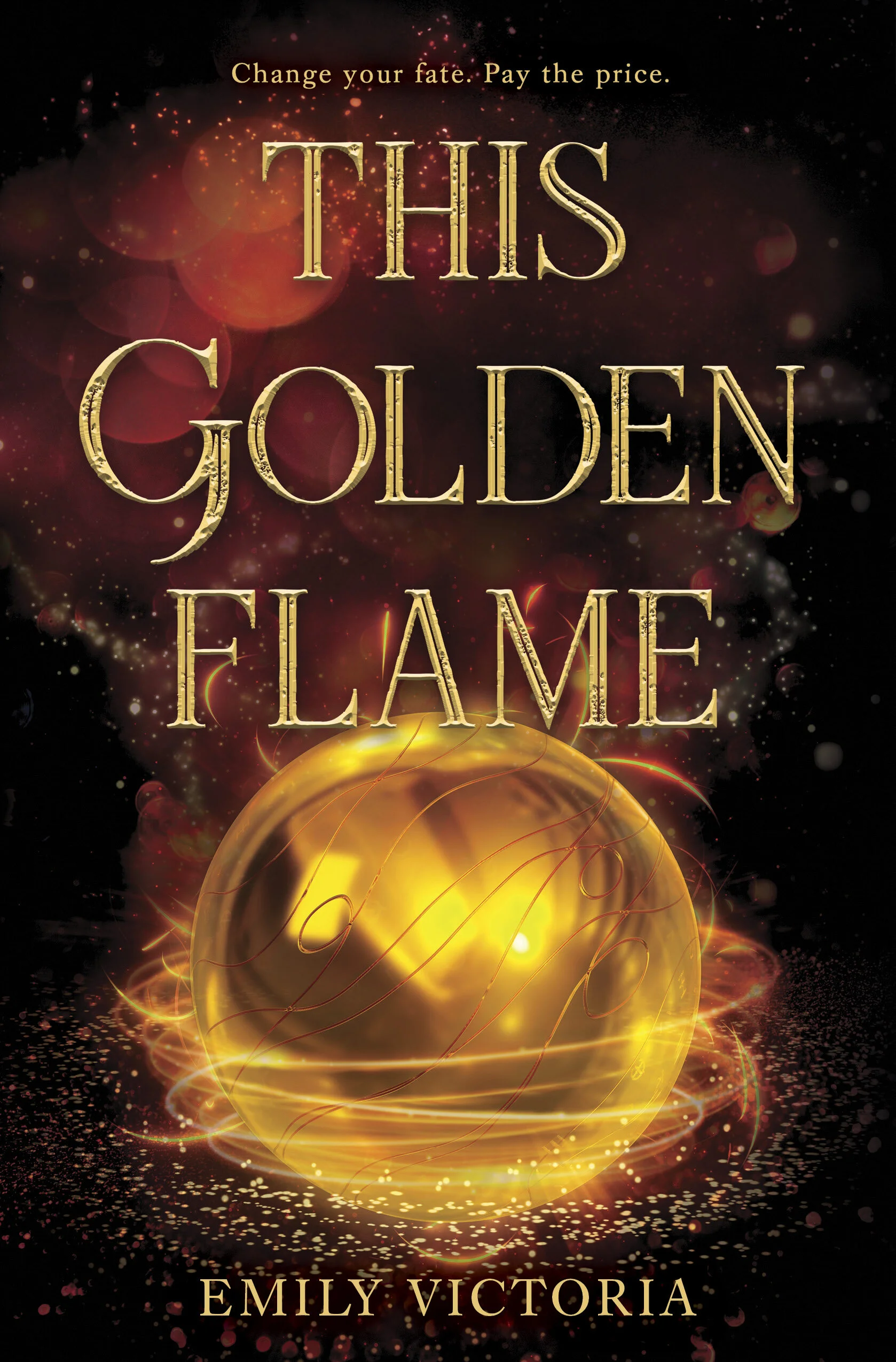
Today’s guest for the SAT is Emily Victoria a Canadian prairie girl who writes young adult science fiction and fantasy. When not word-smithing, she likes walking her over-excitable dog, drinking far too much tea, and crocheting things she no longer has the space to store. This Golden Flame is her debut novel. 

Are you a Planner or Pantster?

I actually started as a Pantster, but then one year I decided to do NaNo, and I knew I was (obviously) going to have a tight writing schedule. I thought that an outline might help me write more efficiently, and I’ve been a Planner ever since.

I tend to write pretty in-depth outlines, with many, many cue cards. For the most part my novels follow my outlines quite closely (at least in plot—sometimes my characters do their own thing). I like having a clear idea of where I’m going before I start out, so outlining works really well for me.

How long does it typically take you to write a novel, start to finish? 

Timelines have been all over the place for me, especially now that I’m juggling more than one project on a deadline, and sometimes a novel has to sit on the backburner for a few months. The fastest I’ve ever written a novel was two months (not including editing time) and the longest took over two years. I do find that in general, I am getting faster at finishing novels. 

Do you work on one project at a time, or are you a multi tasker?

I usually have at least two on the go. My ideal writing situation is when I have one in the first draft stage and one in the editing stage, because switching modes like that helps to keep my brain fresh. However, the editing stage tends to take me quite a bit longer than the first draft writing stage, so that doesn’t always happen.

Did you have to overcome any fears that first time you sat down to write?

I’ve been writing for as long as I can remember, so I wouldn’t say I had fears that first time. When I started getting nervous was once I had an agent and an editor, and I wanted them to like what I had written. However, for the most part I’d say it was a good nervous. 

How many trunked books (if any) did you have before you were agented? 

So many. I wrote eight books before I got my agent, and the novel that I signed with isn’t my debut either. It was a long process. 

Have you ever quit on an ms, and how did you know it was time?

I’ve certainly had to quite more than one manuscript. Some of these were as I was learning the craft, and I eventually realized that the novel just wasn’t strong enough. For others, especially novels I queried, as I received feedback and rejections I would gradually come to accept that the novel was dead (so to speak). However, I would always be working on at least one other project and that helped, because I had something else still to work on (and to, you know, transfer all of my hopes and dreams to).

Who is your agent and how did you get that "Yes!" out of them? 

My agent is the wonderful Rebecca Strauss, and I had a pretty typical path to signing with her. I sent a query and she liked it and asked for some initial pages, then the whole thing, and then I signed with her. 

How long did you query before landing your agent? 

I wish I had kept my early querying stats so that I could give a better answer to this question. I queried four novels, and with the last two alone I was nearing 100 rejections, so it was a lot, over many, many years.

Victoria.png

Any advice to aspiring writers out there on conquering query hell? 

Find a support group of people who will encourage you when you need it (and distract you when you need it). And don’t give up. I received dozens of rejections on the novel I eventually signed with. All it takes is one yes, and that yes can come at any time. I remember feeling like my career was going nowhere right up to the time when my agent’s e-mail landed in my inbox.

How much input do you have on cover art?

I was surprised at how much input I did have—I always thought the author wasn’t allowed much say. But my publisher asked me about past covers that I really admired, and wanted to know if there was anything I really wanted (or didn’t want) to see on the cover. And the end result was so amazing! I couldn’t be happier with it. 

What's something you learned from the process that surprised you?

One thing that surprised me (besides how much input I had on the cover) was just how wonderful and supportive everyone in the industry is. It’s not that I thought the people in the industry would be negative or unkind, but I will admit that before I got my agent and my book deal, I sometimes found the idea of industry professionals intimidating. However, everyone I’ve met has just been so lovely, and it’s been great being able to work with them all.

How much of your own marketing do you?  Do you have a blog / site / Twitter?

Marketing is still something I’m learning to do (and will no doubt continue as a lifelong learning process). I’ll be running a preorder campaign closer to my book’s release, and I’m also a part of the 21ers debut group, which has been a wonderful experience. Probably my favorite type of marketing and promotion is on the visual side: making graphics and trailers for my book.

For social media, I really enjoy twitter, as I find a lot of fellow readers and writers there. It’s a fabulous community. My handle is @avictoriantale (https://twitter.com/avictoriantale). I’m also on Instagram, at @avictoriantale (https://www.instagram.com/avictoriantale/) again.

My website is: https://www.avictoriantale.com/

When do you build your platform? After an agent? Or should you be working before?

I’ve always heard that you should get started before you get an agent, though I will admit, I didn’t seriously get involved in my platform until after I had sold my first book. Once I had that first book deal, I did find it easier, as then I could join debut groups and find a really solid community of writers that I could support and that supported me. 

Do you think social media helps build your readership?

I think connections between writers and readers is so important, and building those connections is easier than ever with social media. So in that sense, I do think that social media can really help with building those connections.