3 Tips to Keep Your Career Rolling During A Pandemic

by Sara Fujimura

My first traditionally-published YA book, EVERY REASON WE SHOULDN’T (Tor Teen), launched on March 3, 2020. And there was much rejoicing! For about a week. Then ERWS promptly fell into the COVID19 Abyss along with pretty much the entire Spring 2020 catalog. Whether you were the big fish scheduled for a 10-city book tour or the tiny minnow throwing your own launch party catered by Costco, COVID19 was the great equalizer. Launch parties, book festivals, book tours, and other fun in-person marketing events all went *poof* overnight. Yep, there was a lot of Charlie Brown, Lucy, and the Football going on.

I was understandably disappointed, but there was a silver lining. I’m a hybrid author with two indie-pubbed YAs under her belt, so I’m used to doing my own marketing. Yes, Tor Teen can do things that I can’t, like getting reviews from NPR and making it onto Buzzfeed specialty lists. But I can also do things that Tor Teen can’t. So, if you’ve finished Netflix, baked enough bread to feed a small village, and created a TP-hand sanitizer-Oreo stockpile that would make a doomsday prepper envious, it’s time to get to work. Here are three things you can do TODAY to get your writing career rolling whether you are indie-pubbed, traditionally-pubbed, or a hybrid:

#1--EXPERIMENT WITH SUPER-TARGETED MARKETING

When my second indie-pubbed book came out in 2018, I hired two local HS teachers to create curriculum for me. BREATHE is set in 1918 Philadelphia against the Spanish Flu pandemic and is rich in both science and history. The resources have been on my website for over a year now and have mostly garnered…*crickets.* Fast-forward to April 2020 when a nation of parents and teachers were desperately trying to figure out how to make distance learning work. The Society of Children’s Book Writers and Illustrators (www.scbwi.org ) asked its members for content of all kinds and levels so teachers and parents could have free, quality activities at their highly-sanitized fingertips. So, I dusted off my suddenly extremely relevant, teacher-created, pandemic curriculum and sent it over to SCBWI. Though I can’t track specific sales of BREATHE to the SCBWI promo, I did see an exponential jump in sales from April to June. What about you? Can you create something (a how-to blog post, newsletter article with a short science lesson, an Instagram post featuring a vintage recipe, etc.) for your audience which can be passed along to their like-minded friends? Can you offer up your expertise in a particular subject that ties into your books for a Zoom workshop for a school, club, or organization?

#2--STOP LEAVING MONEY ON THE TABLE

Is there a list of email addresses collected at your last event gathering dust in your office? Have you been too busy in the past to update your email newsletter list? These are people who WANT to hear from you. There are whole courses on building email funnels and optimizing your email-opening rates, but it’s okay to start with the basics and build. One caveat: Make sure you are GIVING readers something along with your “Buy my book!” pitch. It could be a new short story with beloved characters, a bonus chapter cut from a published book, or a behind-the-scenes look of your latest project. If that feels too overwhelming, try a recipe for a food your characters eat. Or invent a themed cocktail readers can sip while enjoying your book. Create something fun, light-hearted, and connecting. It may not result in a sale right away, but you’re building momentum toward your bigger brand.  

Fujimura.png

#3—EXPAND YOUR CIRCLE

“It’s not what you know. It’s who you know.” This adage is 100% true. Indie-pubbed authors, if anybody ever looks down their nose at you and says that indies never get to sign at book festivals, be on writing panels, or see their books in Barnes & Noble, feel free to point at me. I’ve done all of the above multiple times in the last three years. Thank you very much. And that was BEFORE my traditionally-published third book came out. How? Connections. How do you make connections? Join a writing organization. I write romantic, coming-of-age stories for teens. Therefore, I belong to both the Society of Children’s Book Writers and Illustrators (www.scbwi.org ) and the Romance Writers of America (www.rwa.org ) and have been very active in my regional chapters for many years. It might feel a little squidgy, but this is a form of both short-term and long-term marketing. Absolutely don’t be pushy about your books, but being that helpful, experienced writer who answered a newbie’s question is a form of marketing. Be an active member of your chapter. Volunteer to check people in at your regional conference (one day!). Do a writing craft workshop for your chapter. Mentor a newer writer. Join a subcommittee. Can’t afford a membership fee right now? Lift up other authors in your genre by retweeting their book cover reveals, showing up to their book launches (one day!), and bragging on them when they win an award. All the good you put out will come back to you. Case in point, while I was writing this post, an SCBWI-Arizona friend from the other side of town pinged me that her local library branch is looking for books from Arizona authors and that I should apply. This is the same author who I invited to be part of a special event at MY local library earlier this year. See, it’s not squidgy!

There you go. As someone with a degree in Public Health Education who wrote a book about the Spanish Flu pandemic of 1918, I need to give you a hard truth…COVID19 is going to be here for a while. So stop waiting for publishing to go back to normal and take the reins on your career today.

From Writer, Writer, Pants on Fire: If you desire to find an interesting writer job, you can check out some job search websites to accelerate your job search.

Sara Fujimura creates stories for intelligent, adventurous, globally-minded teens who aren’t afraid to fall in love with someone completely different than themselves. Sara started as a journalist, so it is no surprise that her young adult books contain a lot of facts to go along with the fiction. Whether you want to know about Nagoya, Japan (TANABATA WISH), the Spanish Flu pandemic of 1918 (BREATHE), what it’s like to be an Olympic-caliber skater (EVERY REASON WE SHOULDN’T), or how unscripted television works (FAKING REALITY, Tor Teen, July 2021), Sara takes the reader on a swoony journey to unusual places. She is a creative writing teacher, literacy advocate, and is excited to support the next generation of authors.
Find Sara on Facebook, Twitter & Instagram

YA Author Annie Sullivan on Creating Swag that Works

Most authors will agree that the creative part of the job is where we excel, the business and marketing side, slightly less. It’s lovely when the two can meet in the form of SWAG – Shit We All Generate. I’ve invited some published authors to share with us their secret to swag… little freebies that can sell a book longer after the author is no longer standing in front of a prospective reader. In order to create great swag, you have to be crafty – in more ways than one.

Today’s guest for the SWAG is Annie Sullivan, the author of the young adult novels A Touch of Gold, Tiger Queen, and A Curse of Gold. She lives in Indianapolis, Indiana, and she loves fairytales, everything Jane Austen, and traveling and exploring new cultures. When she’s not off on her own adventures, she’s working as the Senior Copywriter at John Wiley and Sons, Inc. publishing company, having also worked there in Editorial and Publicity roles. She loves to hear from fans, and you can reach her on Twitter and Instagram.

Sullivan .jpg

Finding something that represents your book and hasn’t been played out by a million authors before is difficult. What’s your swag?

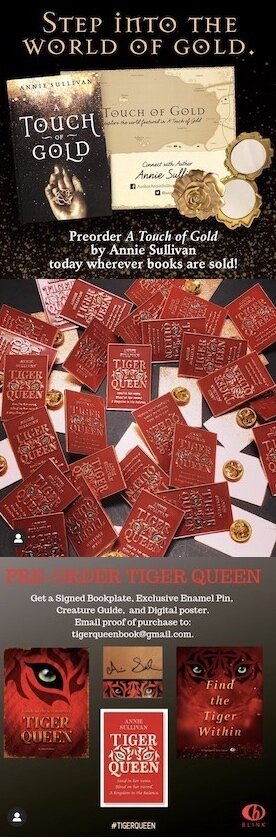
The swag I send out depends on the book. For my first book, A Touch of Gold, I found these amazing gold compact mirrors in the shape of a rose to send out to all those who preordered. It fit perfectly with the golden hand holding a gold rose on the cover of the book. I also did bookmarks, bookplates, and a digital map of the world. 

For my second book, Tiger Queen, I did enamel pins of the book cover that really stood out because of the tiger eyes depicted on them. I will say those pins were hard to mail since I had to wrap them well so they wouldn’t ruin anything else in the package of tear through the envelope. With those, I also sent bookmarks and signed bookplates. Then, I sent a digital poster and guide to the creatures that live in that world digitally. Also, since Tiger Queen is set in a desert that’s running out of water, I also had some custom water bottles made with the book cover and tagline on them. I gave those out at conferences, and they were a big hit.

Finally, for my new novel, A Curse of Gold, I’m leaning toward something that’s easier to send because of the pandemic. So I’m exploring options like character art cards, posters, and digital content.

I always try to do a mix of digital and physical content so that people that like different types of SWAG have something that appeal to them. 

How much money per piece did your swag cost out of pocket?

A lot. I probably paid, including shipping, about $5+ total per person who got SWAG—and way more for international preorders. It was definitely a lot, and while I do typically see high preorder numbers because of it, it’s not something that’s sustainable for multiple books.

Do you find that swag helps you stand out at an event? (or) Does your swag draw people to your table at an event or conference?

For me, SWAG has always been more of a way to incentivize people to preorder my book. But if I have extras, I give them out as prizes at my book launch, conferences, or school visits. Having these items on your table can be a great way to get readers to approach you at an event because you can offer them something for free and then engage them to see what books they like to read.

What do you think of big item swag pieces versus cheaper, yet more easily discarded swag like bookmarks?

Personally, bookmarks always get lost or crushed in my bag as soon as I shove them in there. So while I definitely hand out bookmarks—almost like business cards—I prefer something more substantial that’s not going to be thrown out the second someone gets home from an event. Then again, bigger, more expensive items are harder to ship and cost more. So there’s a lot of give and take in what you decide to use for swag and what you think will resonate with your readers the most.

Sullivan.png

What’s the most clever / best swag by another author?

Personally, I love posters of book covers. They aren’t horribly expensive, and if a reader loves a book or a cover, they’re more likely to display that then something that’s easily lost or wrinkled like a bookmark. For example, I love the Renegades poster I got at BookCon from Marissa Meyer. It’s a fun way to combine character art with book covers.

And the biggest question – do you think swag helps sell books?

Overall, yes. I think it can tip the scales for someone who might be on the fence about getting a book. When they see a cool preorder incentive, that might be the push they need to finally click that buy button. At least, that’s what I hope SWAG does!

Using art therapy to combat addiction, depression, and COVID-19

by Patrick Bailey

Many downers in life try to suck every inch of happiness from our existence. Addiction, depression, and COVID-19 are examples of such emotional vampires. They can cause people to be worried, overwhelmingly sad, bored, and lonely. Furthermore, they can cause a person to try to turn to substances such as drugs and alcohol to alleviate the pain. Art therapy is the perfect alternative to turning to harmful substances for a false sense of happiness. It's a tool that anyone can use to combat the conditions and situations mentioned above. Here's some information about it and how it can help.

What Art Therapy Is All About

Art therapy is a method of treatment that involves the arts. It uses a variety of art forms to help people to work through their pain and struggles. Writing or journaling is a form of art therapy, as are painting and drawing. Other examples of art therapy include writing music, playing a musical instrument, sculpting, sewing, knitting, and crafting collages. Many alcohol and drug rehab centers use art therapy to help patients and clients to work through various stages of addiction recovery. Art therapy is also a practice that some doctors use for neurological conditions such as Parkinson's disease and multiple sclerosis. Alternatively, sometimes art therapy plays a role in the lives of abuse survivors as they are trying to find the way to their true selves and their new lives.

Why Art Therapy Helps

Art therapy can help people for many reasons. The benefits list is long, but we'll mention some of the most crucial ones. First, it allows the participants to create something new and something beautiful. Many people in art therapy programs have been surrounded by ugliness in their environments. The artistic activities allow those people to become creators and take control of their lives by making it what they want it to be.

Artistic activities center a person's focus as well. It can help keep an individual grounded and calm while that person is going through the withdrawal stage of addiction, for example. Additionally, the act of creating art can give a person a strong sense of accomplishment. It can help a person to feel as if his or her life has real meaning, or to help them express their feelings in a more indirect but healing way. That feeling is especially important in someone who is suffering from a depressive episode.

Art therapy could provide a person with a strong sense of who he or she is. Many people discover that they have artistic capabilities while they're in art therapy. They may have spent so much of their lives catering to other people that they never got the opportunity to develop fully. Art therapy gives them a chance to do that.

How to Get Started With Art Therapy

An individual who is interested in art therapy can use several methods to get started. He or she can contact an individual art therapist who can work with the person to use art in its purest form to help combat life's struggles. A person who is working through addiction can contact rehab drug centers to find a facility that participates in art therapy as a part of its overall program. The best way to find out what a facility offers is to contact the facility directly and request to speak to an administrator. Another way to get started with art therapy is to take an art therapy course.

Another way that person can get involved with art therapy is to go it alone. The individual should take a few days to think about which artistic activity is the most appealing to him or her. The individual should then research (if needed) and write down a list of all the materials that will be necessary to perform the activity. For example, the person might need colored pencils and construction paper for a drawing activity. The person can start any time after he or she gathers the appropriate materials. The best way to do it is just to do it. It will be exciting for the individual to see the lovely creation at the end of the activity.

Start Taking Control with Art Therapy

You've just read a brief description of what art therapy is and how it can be of assistance to different people.

Art therapy can be an exciting new way for you to get in touch with your inner artist and use this process of discovery to work through complex emotions. You might want to give it a try if you're in any of the situations mentioned above. Art therapy may also be worth considering if you've tried other therapies and they haven't worked for you. You can use any of the methods mentioned above to start your journey of using art therapy to help yourself. You'll be a lot happier and healthier in the end. Remember, there's no wrong way to recover. The only wrong thing that you can do is to fail to try.

Author Bio: Patrick Bailey is a professional writer mainly in the fields of mental health, addiction, and living in recovery. He attempts to stay on top of the latest news in the addiction and the mental health world and enjoy writing about these topics to break the stigma associated with them.