The Initial Insult is Out Now!

An Amazon Best Book of the Month! In the first book of a suspenseful YA duology, award-winning author Mindy McGinnis draws inspiration from Edgar Allan Poe and masterfully delivers a dark, propulsive mystery in alternating points of view that unravels a friendship . . . forevermore. Perfect for fans of One of Us Is Lying and Truly Devious!

Tress Montor’s family used to mean something—until she didn’t have a family anymore. When her parents disappeared seven years ago while driving her best friend home, Tress lost everything. The entire town shuns her now that she lives with her drunken, one-eyed grandfather at what locals refer to as the “White Trash Zoo.”

Felicity Turnado has it all: looks, money, and a secret. One misstep could send her tumbling from the top of the social ladder, and she’s worked hard to make everyone forget that she was with the Montors the night they disappeared. Felicity has buried what she knows so deeply that she can’t even remember what it is . . . only that she can’t look at Tress without feeling shame and guilt.

But Tress has a plan. A Halloween costume party at an abandoned house provides the ideal situation for Tress to pry the truth from Felicity—brick by brick—as she slowly seals her former best friend into a coal chute. Tress will have her answers—or settle for revenge.

I’m so excited for this book to get out into the world! The Initial Insult draws on short stories from Edgar Allan Poe - specifically, The Cask of Ammontillado, The Black Cat, and The Masque of the Red Death. I’ve been pitching it as The Tiger King meets Edgar Allan Poe… which is pretty accurate.

One of my emails to my editor inquired - how much puking is too much puking?

That’s the kind of book this is. I hope you enjoy it!

Elaine Vickers On Inspiration & Writing With Friends

Inspiration is a funny thing. It can come to us like a lightning bolt, through the lyrics of a song, or in the fog of a dream. Ask any writer where their stories come from and you’ll get a myriad of answers, and in that vein I created the WHAT (What the Hell Are you Thinking?) interview. Always including in the WHAT is one random question to really dig down into the interviewees mind, and probably supply some illumination into my own as well.

Today’s guest for the WHAT is Elaine Vickers, author of Fadeaway. Elaine is an award-winning author of picture books, middle grade, and young adult novels that aim to help readers of all ages find connection and belonging. .

Ideas for our books can come from just about anywhere, and sometimes even we can’t pinpoint exactly how or why. Did you have a specific origin point for your book?

This book began with a character—and I think this is the first time that’s been true. Just a kid missing his older brother, Jake. Where was he? What happened to him? He didn’t know, and neither did I. Over the next few months, we figured it out together.

 Once the original concept existed, how did you build a plot around it?

Not long after that initial character appeared, I attended a youth night with my son and listened to a speaker tell his own powerful story of addiction and struggle and love and redemption. It was like a lightning bolt; although none of the details were the same, the man at the mic had just articulated the core of the story I needed to write. He had helped answer both essential questions of where Jake had gone, and why. But I knew it wasn’t going to be a linear story from a single perspective, because that’s not how addiction works, or how life works, for that matter. From there, I knew that in order to tell this story the way I wanted to, I needed to give voice to all the people who loved Jake—and even a few who didn’t.

Have you ever had the plot firmly in place, only to find it changing as the story moved from your mind to paper?

I often know where a story ends and a few guideposts along the way, but the actual journey never ceases to surprise me. For Fadeaway, one of the biggest surprises was how many lives were impacted in really huge ways by Jake’s disappearance. (I ended up with POV characters ages 11-85!) But of course that’s how it would work. Our lives are more interconnected than we realize.

And I honestly never intended to write a YA. Fadeaway started out as a middle grade novel in verse—which I also never intended to write. Nothing I’ve ever written has surprised me as much as this book—at every turn, and in every possible way. But eventually, it became what it needed to be, I think.

How do you choose which story to write next, if you’ve got more than one percolating?

Vickers.jpg

I have a note in my phone called Seed Packet where I jot new ideas. At last count, there were about a hundred ideas in there for everything from picture books to plays to novels. Very few of them are actually viable to grow into anything good. Ha! But it’s strange (or maybe not strange at all) how a story seed can seem totally unviable one day and brimming with possibility another. So I go through life, gathering all the tiny seeds of ideas, then open the packet when I’m ready to play around with something and try planting it. Whichever is speaking to me, whichever one I just can’t wait to play around with, that’s the one I pull out.

I have 5 cats and a Dalmatian (seriously, check my Instagram feed) and I usually have at least one or two snuggling with me when I write. Do you have a writing buddy, or do you find it distracting?

Ha! That is truly an impressive number of cats!

For me, writing is largely a solitary endeavor, but sometimes I do love to gather with friends for a writing retreat. (Well, when there isn’t a global pandemic. J) There’s something energizing about the crackle of keyboards and the hum of ideas that happens when you’re all working together. (And the social pressure to keep writing while your friends are being productive doesn’t hurt either.)

Kate Weinberg On Writing From Theme, Not Plot

Inspiration is a funny thing. It can come to us like a lightning bolt, through the lyrics of a song, or in the fog of a dream. Ask any writer where their stories come from and you’ll get a myriad of answers, and in that vein I created the WHAT (What the Hell Are you Thinking?) interview. Always including in the WHAT is one random question to really dig down into the interviewees mind, and probably supply some illumination into my own as well.

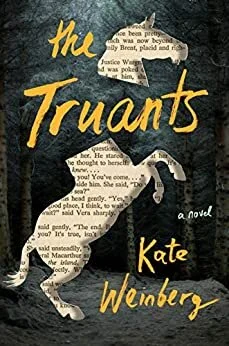
Today’s guest for the WHAT is Kate Weinberg, author of The Truants, one of the New York Times Book Review’s 10 Best Crime Novels of 2020. Borrowing details from the life and work of Christie as the catalyst for its ingenious plot – in particular her mysterious, 11-day disappearance in 1926 – this scintillating novel begins on an otherwise unglamorous concrete campus in England’s gloomy north and ultimately travels to a remote Italian island where secrets and cloudy motives will lead to unforeseen consequences. The result is not a classic mystery in the Christie school, but rather a literary novel of suspense that explores themes of female friendship, love, deceit, obsession, mentorship, loyalty, art, and death.

Ideas for our books can come from just about anywhere, and sometimes even we can’t pinpoint exactly how or why. Did you have a specific origin point for your book?

How long have you got?! My book started forming itself about 15 years before it was published. I studied in a famous creative writing programme in Norfolk, England, where my English literature teacher, Professor Lorna Sage, became the inspiration for the Lorna in my book. Although I am quite different from my narrator, Jess, and I pushed her relationship with the Lorna in my book into much deeper, darker corners, the spark for the story was the same: I was that student, longing for a mentor and romance, desperate for an intellectual and emotional wake-up that would lay the path for an extraordinary life. 

Once the original concept existed, how did you build a plot around it?

With a huge amount of trial and error! It was like trying to solve a Rubik’s cube. I knew some of the characters I wanted (Lorna, Jess, and a love interest); I knew the themes I wanted to tackle – wanting to vanish from your old life and be seen afresh in a new one – and I knew I wanted a murder mystery element because I’ve always loved books with a taut, suspense element. So I was constantly adding and then rebalancing between character and story. I feel like if you could make a cross-section of the process of The Truants you’d find as many layers as you’d have in a thick pastry! 

Have you ever had the plot firmly in place, only to find it changing as the story moved from your mind to paper?

With me, it’s more the other way round: I don’t have the plot firmly in place before I get to the writing stage. I have a real sense of characters, themes and a loose sense of the story, and then as I write I have to fix the story. 

Weinberg.png

Do story ideas come to you often, or is fresh material hard to come by?

Plenty of ideas come, but not many stick around. I find one of the most rewarding things as a writer is to excavate old ideas – which have never come to anything – and realise that I can now see a way to making them come alive.

How do you choose which story to write next, if you’ve got more than one percolating?

I’m a slow writer, so I don’t have that problem. I’m now working on a second book which has even more autobiographical roots than the first one, so I always knew I wanted to write it. I just feel now that I am ready.

I have 5 cats and a Dalmatian (seriously, check my Instagram feed) and I usually have at least one or two snuggling with me when I write. Do you have a writing buddy, or do you find it distracting?

It depends what stage I’m at. If I am in the first draft I find it really helpful to have another body in the room, and to have set up a structure for a day, with breaks: it stops me procrastinating and seeking out company and connection (annoyingly I am not solitary, or disciplined by nature.) But if I am into one of the last drafts and I have momentum I’m better off working by myself. I can write deep into the night, and when its flowing like that, I never feel lonely.