Robert Steven Goldstein on Inspiration

Inspiration is a funny thing. It can come to us like a lightning bolt, through the lyrics of a song, or in the fog of a dream. Ask any writer where their stories come from and you’ll get a myriad of answers, and in that vein I created the WHAT (What the Hell Are you Thinking?) interview. Always including in the WHAT is one random question to really dig down into the interviewees mind, and probably supply some illumination into my own as well.
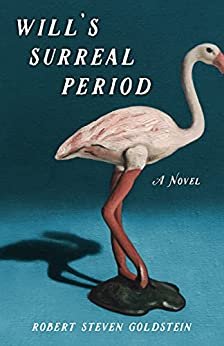
Today’s guest for the WHAT is Robert Steven Goldstein, a critically acclaimed author, taps into his childhood experiences with a dysfunctional family to interrogate the bond between loved ones and what it takes to mend broken relationships. Goldstein’s deep love for art and creativity is reflected in his vibrant cast of characters as they each find their own path to self-discovery, even if that means choosing themselves over family.

Ideas for our books can come from just about anywhere, and sometimes even we can’t pinpoint exactly how or why. Did you have a specific origin point for your book?

For my new novel Will’s Surreal Period, there was, indeed, a brief twinkle of inspiration. It stemmed from an article I read about a sculptor who had developed a unique style of work which was much admired—only to learn that the artistic style was actually the product of a life-threatening brain tumor. The only way for the artist to save his life was to have the tumor removed—but that would have meant sacrificing his art as well. According to the article, the artist had not yet made a decision about what to do.

Once the original concept existed, how did you build a plot around it?

 That heart wrenching dilemma about the artist and the brain tumor was just the kernel of an idea. The story for Will’s Surreal Period now needed to be fleshed out, other characters with their own problems and paths needed to be dreamed up, and a real plot needed to be created. That’s the point for me where the twinkle of inspiration gives way to some real work. I don’t know how other writers do it—I suppose some mark up index cards, or make copious notes, or create some verbal equivalent of a storyboard. I must confess, though, that I don’t do anything quite so concrete. I just go into a sort of writer’s trance and ponder obsessively for a week or two—sometimes sitting around, sometimes hiking with my dog, sometimes showering or shaving or eating, and even sometimes when I’m ostensibly focusing on something that I really need to (like a conversation with my wife about an upcoming social engagement—in which case it never takes her long to figure out that my mind is someplace else). My internal process for the story always starts with the characters. When a few of those have finally materialized, relatively firmly in my mind, I then work through the barest outline of a plot. That’s really all I need to start writing.

Have you ever had the plot firmly in place, only to find it changing as the story moved from your mind to paper?

I actually never have the plot firmly in place! I think if I did, I’d find the act of writing tedious. For me, the pleasure of writing is figuring it out as I go, letting the last incident I dreamed up lead to another and another. Some years ago, I wrote a novel that had a bit of a murder mystery in it, and I honestly didn’t know who did it or how it would be resolved until I got there. I suppose there are spirited pros and cons to such an approach, but for me, one very good thing was that it kept me as curious and engaged along the way as I hoped my readers would be.

Do story ideas come to you often, or is fresh material hard to come by?

Big ideas, those that can actually serve as the kernel for a new book, don’t come to me often at all. But little ideas—what will happen next in the story, what new character might suddenly pop up in this chapter, what unexpected twists do I now envision down the road—those manifest constantly, but only when I’m actively writing.

How do you choose which story to write next, if you’ve got more than one percolating?

It’s hard enough for me to get one good idea for a book percolating. Which is probably for the best, because novels take a good while to churn out—there’s a relatively finite number of them that I’m going to wind up producing in my life—so the kernel of an idea for a book becomes a very important decision. The fact that I rarely have more than one at my disposal at any given time is probably a blessing—no need to agonize over which to pick—and no torturous second-guessing, months later, that I’ve been toiling over the wrong idea for the past two hundred pages.

I have 6 cats and a Dalmatian (seriously, check my Instagram feed) and I usually have at least one or two snuggling with me when I write. Do you have a writing buddy, or do you find it distracting?

My big old dog Cali, a ten-year-old Akita Inu and Blue Heeler mix, is sprawled out on the couch in my office at this very moment, watching intently as I type. I think she somehow realizes that although there is no dog in Will’s Surreal Period—two of the main characters do own a cat…

Life Lessons from Growing up on a Farm

by Carolyn Dallman

Faster and faster, my brothers and I tossed hay from upper bins of the loft to the middle bin, then down the chute. The sooner we finished this task, the sooner we could begin jumping from the upper bin to the lower bin, like a trampoline.  Our play started with random jumps, but soon escalated to challenges: side jumps, butt jumps, belly flops, maybe a somersault … until the landing pad became packed solid and touchdowns hurt.

Hard work and hard play went hand-in-hand on our farm in North Freedom, Wisconsin, during the 1950s. This concept was likely instilled in children living in cities during the 1950s as well. However, the differences between living in cities and living on family farms were the unique tasks associated with farm life and experiencing the intricacies of operating a dairy farm. My parents taught these skills to my brothers and me by example, not by telling.

Daily tasks were assigned, but we were expected to adapt to specific situations. For example, the process of feeding our dairy cows changed with the seasons. When pastures were green with grass, cows did not need that forkful of hay at their stanchions. With their bellies full, cows were not inclined to return to the barn twice daily for milking. However, a scoop of ground feed on top of a mound of silage enticed the animals into the barn.

During long Wisconsin winters, huge mounds of hay were needed to supplement the green grass missing from the cows’ diets. (Each animal needed a bathtub full of hay each day.) These changes in feeding our dairy cows did not happen abruptly. Rather, the amount of hay, silage and ground feed were adjusted according to weather conditions. My brothers and I learned how to make these adjustments without directions from dad or mom.

We learned about planting and harvesting. Crops were rotated annually to naturally enrich the soil. I did not fully understand the reasoning behind this until I was in high school, studying earth science and biology.

Nitrogen-rich soil from our legume crops of alfalfa and clover was fertilizer for eventual fields of corn. Alfalfa was planted with oats. Oats grew fast, turning a rich golden color before the summer harvest. This allowed green alfalfa to continue growing in the same field and producing a crop of late summer hay. The following spring alfalfa sprang up to a bright green crop of hay in that same field. It could be harvested as many as three times during the summer. The following spring, that nitrogen-rich soil was tilled and became fertilizer for our newly planted corn.

Our equipment was not new. It worked well enough, but it was not unusual for something to break down. My brothers and I watch as dad did the repair, and we were ready and willing to collect tools that dad might need. Sometimes we were asked to assist with the repair under dad’s watchful eye. I learned how important it is to return tools to their proper place so they would be readily available the next time something broke.

Perseverance and the ability to adapt to unique situations came from those childhood experiences on the farm. I saw dad and mom go through myriad situations where they needed to adapt. I saw their work ethic and the methodical ways they accomplished tasks. They did not explain these things to me. It was a way of life absorbed into me through their examples.

Their examples carried me through coming-of-age moments when I had to stand on my own two feet. It gave me strength through the challenging years of raising a family. It gave me confidence in my professional career.

The diversity of tasks learned on our family farm served as important resources for me and continues to have a positive impact as I celebrate having my debut book, North Freedom, published.

Upon hearing a story of his grandmother’s childhood, Carolyn’s 7-year-old grandson said, “Grandma, you are so lucky. I can’t do those things. Life is different today.” The conversation with her grandson concerned Carolyn. Was the childhood of the baby boomer generation being lost? Could she use childhood memories to preserve the way of life she had experienced?

North Freedom is a collection of over 60 interrelated, nonfiction stories blending a variety of characters, activities and events that dynamically move on the static landscape of the village and the farm.

On The Novel Spectrum

by Mark Zvonkovic

I think of novels on a spectrum, one end of which is Pop Entertainment and the other end being Art. The categories are not intended as criticism. They are only meant to help me choose what kind of book I want to read. And that will generally reflect how I’m feeling: pensive, distracted, studious, energetic, ­you get the picture. And, of course, an important consideration will be whether I am going to read or listen to the book.

Character development is what really interests me in a novel. Some readers may not find characters as engaging as fast and exciting plots, where the background of a protagonist is not as interesting as the action taking place. These novels would include thrillers and romance, generally, although there are plenty of genre blended novels with very well developed characters. Readers who want to make deep personal connections with a story often enjoy novels with mixed genres and complex characters. In E.M. Forester’s words, one must “only connect” to find meaning in relationships, and how wonderful can it be for a reader to make a strong connection with a protagonist. In my writing I work hard to put myself into the heart and soul of the characters and then create a plot around them to make an observation about life.

In my third novel, Belinda, I took a lot of time putting myself in the place of the protagonist Lyn Larkin. Of course, this was particularly difficult for me for no other reason than that Lyn was a woman and I a man. But I had the advantage of working for almost forty years in a law firm, where a lot of the novel’s action occurs, and I was very lucky to have mentored a number of young women associates during those years. It made a tremendous impression on me that these women in a professional setting always had to overcome the fact that the prevailing ethos around them was so male slanted. It wasn’t the blatant misogynistic attitudes, like the ones displayed so prominently in my novel by the antagonist, Patrick Brashner. The more difficult obstacles grew out of subtle attitudes and proclivities of many men, which often made the women feel as if their bodies were being evaluated as much as their brains, if not more. And for me this is what Belinda is about, how dedicated this woman was to her profession and how elegantly she managed to make herself a success despite the male ethos she encountered daily.

My novel Belinda is written from several points of view, all but Lyn’s being those of men. I know that a good writer shows, doesn’t dictate. It was hard for me to learn this after so many years of drafting contracts, but I’m making progress. It was the men’s points of view that I used to display the male ethos in Belinda, particularly the subtle attitudes that some of the men were barely conscious of. It was the character Will Baines, a decent young partner in fact, who displayed how a man’s actions and thoughts can create an uncomfortable environment for women. Through Will’s thoughts the reader sees how his unmanageable, even adolescent, observations about two women colored his attitude toward them. Of course, sexuality can have tremendous power in social settings, particularly those arising in a professional context, where it is combined with competition and ambition. And, as Lyn demonstrated in several of her actions, the repercussions are not all on the male side.

For me, women characters are some of the most enjoyable people in fiction. And some writers are very adept at creating them. One such writer is Erika Robuck, who writes about women in historical settings. She is brilliant at casting an engaging picture of a historical event by creating deep, complex women, as she did in Sisters of Night and Fog, her most recent novel. Would that she’d been my creative writing teacher before I started writing. My novel A Lion In The Grass is a historical novel that includes World War II events and I know how much work it takes to make a character fit into an earlier time and place.

Readers often ask me, What next? I don’t have a ready answer. I’m a recovering lawyer and I have no intention of ever again filling out a time sheet. Whatever the next story, it will of course focus around a complex protagonist. One of my favorite characters is Larry Brown in my novel The Narrows. In that story Larry is a young man who deals with difficult personal circumstances in the early 1970s. A lot has happened in the world since those years. Perhaps it would be interesting to see how Larry has made his way to the present day.

Mark Zvonkovic is a writer who lives in Rosarito Beach, Baja California Mexico with his wife Nancy and their two dogs. Finn and Cooper. He has written three novels, and he also writes book reviews and essays that appear in online publications. Before retiring to Mexico, Mark practiced law for thirty-five years at three multinational law firms in Houston, Texas and New York City. He attended college at Southern Methodist University and Boston University, and his law degree is from SMU School of Law. Mark grew up as an oil company brat and lived in Latin America, Texas and New York.