
Some Novel Tips for Writers to Beat Creative Crisis

by Dorian Martin

The life of writers is all about ups and downs. One day you feel inspired and can write a hundred pages. The next day you feel broken and can’t find suitable words to finish a sentence.

If you are going through a creative crisis and are looking for help, check out the following tips on how to get your life back on track. Do your best to take control of the situation and find inspiration again.

Practice gratitude

Can you describe yourself as a grateful person? If you do not feel thankful for everything you already have in your life, you should reset your mindset.

Numerous scientific studies have proven there is a link between gratitude and creativity. It means that if you start practicing gratitude, it will be easier for you to beat the creative crisis.

Here are a few tips on how to start a “gratitude journey”:

●      Keep a gratitude journal on a daily basis. Write a list of 5 things you are grateful for.

●      Write “thank you” letters to people who helped you in your life. List all the good things they have done for you.

●      Stop complaining. Focus on things you have rather than things you have lost.

Find a new hobby

If you feel stuck in your life and work, you should find a new way to express your creativity.

Have you ever tried to watercolor flowers, decorate cakes, or play the guitar? Have you ever wanted to learn how to dance salsa or make clay pots? It’s time for you to try new activities and explore new forms of art.

“If you immerse yourself in a new creative hobby, you will unlock your creative potential. You will overcome the crisis and find inspiration for writing,” says Elisabeth Glover, a psychology writer at TrustMyPaper.

Take a look at your past achievements

It’s common that writers tend to undervalue their past achievements and doubt their talents. So if you worry that your writings are “not good enough”, you are not alone with your problem.

To get your confidence back, do the following:

●      Take a look at the best works that you completed in the past few years

●      Choose your favorite passages and read them aloud

●      After that, ask yourself a question: “Is it even possible that such a masterpiece was created by a person who has no talent?”

You do have a writing talent, and that’s an obvious thing! You have already achieved success as a writer once, and you have all the skills necessary to create even better pieces in the future. Reread all the positive reviews you have ever got, and you will get inspired again.

Travel to a new place

Your creative crisis will not end soon if you keep spending all your time in the same place and talking to the same people. To get your writing power back, you should travel to the place you have never been to and meet people you have never seen before.

“Travelling is one of the most effective ways to get positive emotions and find inspiration. So if you have been dreaming about a trip to Paris or Bali, it’s time to make your dream comes true,” says Tom Anderson, a travel blogger and writer at WowGrade.

Go exploring new cultures, tasting new cuisines, and admiring nature’s beauty – and your problems will solve themselves.  

Hike more

Hemingway was a big fan of hiking and mountain climbing. Together with her first wife, he often went on in the French countryside during their years living in Paris. According to Hemingway’s biography, their hikes were typically in the 12 – 20 mile range.

Long-distance hikes helped the famous writer not only to keep a good physical shape but also to avoid creative crises.

So if you like hiking and mountain climbing, try to practice more often. It’s highly likely that it will stimulate your creativity, and you will want to get back to writing. 

In conclusion

Remember that no matter what is going on in your life, everything is in your hands. If you want to feel the joy of writing again, try out the tips given in this article. Make the first step and become a happy, successful writer.

Dorian Martin is a blogger and novel writer. Currently, he works as an editor at Studicus and IsAccurate. His biggest passions are jazz, baseball, and medieval art.

The Saturday Slash

Slash.png

Don't be afraid to ask for help with the most critical first step of your writing journey - the query.

I’ve been blogging since 2011 and have critiqued over 200 queries here on the blog using my Hatchet of Death. This is how I edit myself, it is how I edit others. If you think you want to play with me and my hatchet, shoot me an email.

If the Saturday Slash has been helpful to you in the past, or if you’d like for me to take a look at your query please consider making a donation, if you are able.

If you’re ready to take the next step, I also offer editing services.

Imagine if Alice’s Adventures in Wonderland was thrown in a blender with New Orleans voodoo and queer characters. The result would be a magical mix of adventure, curiosity, loss, belief, and family. We all think we know the story of Alice and perhaps we do, but what we don’t yet know is the story of AMARYLLIS LIDDELL, a queer multiracial girl living with her single mother in Brooklyn, NY. A young adult version of the classic tale blending fantasy and realism, THE TRIALS OF AMARYLLIS LIDDELL is approx. 79,000 words.

What you have right here is more of an elevator pitch, or a mashup. You're taking a concept (Alice) and adding the spice of the other two elements. It's not a bad pitch, but I don't think it's a hook for a query. A mashup is by nature broad, but a hook is very specifically pointing to an event or element in your book that makes it different from other books. Definitely think about what the defining element of your book is, and try to work that into a hook, rather using the language of a mashup / elevator pitch for a query.

THE TRIALS OF AMARYLLIS LIDDELL introduces us to an Alice different from the one we already know. Right now the language that you're using to compare your book with Alice is making it sound more like a retelling than anything else, and with the elements I see in front of me within the query, I'm not sure that's accurate. Feel free to ignore, is that is the gist.

Amaryllis is curious, much like Alice, but she also wishes so strongly that she were brave. Why? What is she scared of? Overall, Amaryllis’ life isn’t so bad. She loves her books, her girlfriend, the city, and all the possibility it represents. She could, however, do without the fights with her mother and the nagging feeling that she wants more from life. She wants adventure and purpose – and most of all, she wants to belong and feel understood. Everything that you're saying so far is very typical of just about any / all YA literature. For a query you want to extrapolate on what makes it stand out, what makes it different. Nothing listed abobve fulfills that.

At the end of her junior year of high school, Amaryllis looks forward to spending her summer running around the city with her girlfriend SOFIA You only capitalize characters names within a synopsis, not a query and to spend her free time with her nose buried in a good book, specifically the many old texts on voodoo, herbal remedies, and charms that have been mysteriously showing up at the studio apartment she shares with her mother, HARRIET. Also, make sure you are a person that can write about voodoo respectuflly and with an understanding of all the cultural connections.

On a sweltering summer day, after a particularly nasty fight with her mother on the subway platform, tragedy strikes Amaryllis’ life. As Amaryllis storms away from her mother, angry about what’s been said, she hears screams and gasps from behind her. Harriet has fallen onto the tracks and died. This is reading way more like a synopsis than a query. It all seems like a freak accident, one that Amaryllis is sure she must be at least partially responsible for. Amaryllis’ whole life turns into a whirlwind of emotion and change as her long-lost aunt shows up to bring her back home – to New Orleans, that is. While in New Orleans, Amaryllis discovers her family’s connection to voodoo and that it was, in fact, her aunt who had been sending her the books all along. Amaryllis makes it her purpose to dive into the art of voodoo and find a way to work through the grief of her mother’s loss. And what better way to cure grief, she thinks, than to bring her mother back from the dead? Good news. I found your hook - it's all the way down here, at the bottom.

As an avid reader of the young adult genre, I set out to write the book I wish had existed when I was a teenager. I wanted Alice to be queer (#ownvoices), to be a person of color, to exist in a world that I recognized – this is how I created Amaryllis Liddell. She is everything I think a 2020 Alice should be and encompasses much of what I think queer young people want to see in their storytelling. Amaryllis suffers enormous loss in more ways than one, which gave me the opportunity to write about a topic that’s so close to my heart. I too, have suffered losses, and so have many other readers in the YA market. They need stories that speak to them, that aren’t afraid to show the pain that accompanies loss and what one young woman is willing to do to fix her pain. Everything before this, (with the excpetion of the #OwnVoices mention) isn't useful in a query. Cut to your accrediations, below. I hold an M.F.A. in screenwriting and currently teach creative writing as an Assistant Professor at Western Kentucky University. My tv pilot script, ‘Til Death (a queer drama), earned an honorable mention at the University Film and Video Association conference during the summer of 2019. I have published two poems and two short nonfiction pieces with small presses, and I was the screenwriter for the short film Five, which premiered during the African American Short Films Series from Badami Productions in 2016. Most of my work centers on queer women and trauma.

Great bio if you take out the more personal elements noted above. Also, you are clearly aware of #OwnVoices and are illustrating your fitness for this story in terms of queerness. If you have something simliar to put up front in connection to the multi-racial and voodoo elements, I would advise that, as well.

As I noted above, this is reading more like a synopsis than a query. Get the trauma of loss and the idea of resurrection in there way earlier. It feels like more of a hook than the Alice comparisons. Also, some indications about whether or not this is a good idea (or a bad one), would be great. You say your MC wishes whe were brave, but not why she thinks she isn't, or why she wishes she were.

Writer's Digest shares a series of successful query letters on their site, with feedback from agents who signed the author, and why the query works. Read through some of those to get a better idea of what a successful query should look like.

Mine can be found here.

Alex Perry On Balancing Editing and Drafting Different Projects

Welcome to the SNOB - Second Novel Ominipresent Blues. Whether you’re under contract or trying to snag another deal, you’re a professional now, with the pressures of a published novelist compounded with the still-present nagging self-doubt of the noobie. How to deal?

Today’s guest is Alex Perry, whose debut, Pighearted, comes out in Fall of 2021 and will be published by Little Brown for Young Readers. Pighearted is about a boy with a heart condition. A genetically engineered pig is supposed to be his heart donor, but ends up becoming his best friend.

Is it hard to leave behind the first novel and focus on the second?

Switching my brain from one project to another is hard. It’s my baby. I’m invested. And now I’m letting my baby wander out into the world on her own. But much like letting my baby toddle into the wilderness with a bindle stick and good wishes; it’s ultimately a relief. I did what I meant to do. My first novel, Pighearted, was out of my hands. I was done. I could relax. Until I had to come up with another project.

Perry.png

I was already working on a few different stories when my agent Melissa asked me to come up with a pitch for the next book so we could show my editor. I was in love the concept of Pighearted, so it was tough to try to present some half-baked idea with the enthusiasm I had for my first book. So I had to fake it.

I was in the emergency room with my mom as I typed out a handful of different pitches. When you’re in the middle of a medical catastrophe that takes the air out of any impostor syndrome. Self-doubt didn’t seem to matter as much because all I had to do was sit there next to the beeping machines and type. I got it done, but more importantly my mom got to go home and was okay. My wonderful agent helped me pick the best idea and I had to agree with her. That pitch flowed much more easily than the rest and I should have known that it was the one.

At what point do you start diverting your energies from promoting your debut and writing / polishing / editing your second?

As soon as Pighearted went on sub, I started trying to find the next thing. I knew that little piggy had gone off to market and was out of my hands for now. There were some false starts. I relied on my agent to rein in my more ridiculous impulses and pick a second story that would work for me. Now it’ll be a juggling act based on when I get editorial letters and revision deadlines. I’m planning to finish drafting my new novel in time to dive into edits. While I wait for feedback on those edits, I’ll revise my new novel, and switch back and forth like that until fall.

Your first book landed an agent and an editor, and hopefully some fans. Who are you writing the second one for? Them, or yourself?

I feel like the “correct” answer is should be that I always write for myself. But that’s a lie. I see writing as a business that I want to succeed in, so I’m trying to make something that’ll be marketable and appeal to the kids I want as my fans. Everything’s for them and I use agent and editor input to figure out what’s best for those hypothetical kids.

Is there a new balance of time management to address once you’re a professional author?

I really should figure out time management, but I haven’t gotten around to it. Maybe I will next week? I’m terrified of this new book. I drafted the first one in three weeks and have been plugging away at this one for about three months, if that tells you anything. I’m constantly wondering if it is funny enough, emotionally engaging enough, and if the characters resonate enough. With the first book, I didn’t have anything on the line. Just finishing that book was an accomplishment. This time could fail and actually disappoint professionals in the industry. That makes it tough to manage my time effectively.

What did you do differently the second time around, with the perspective of a published author?

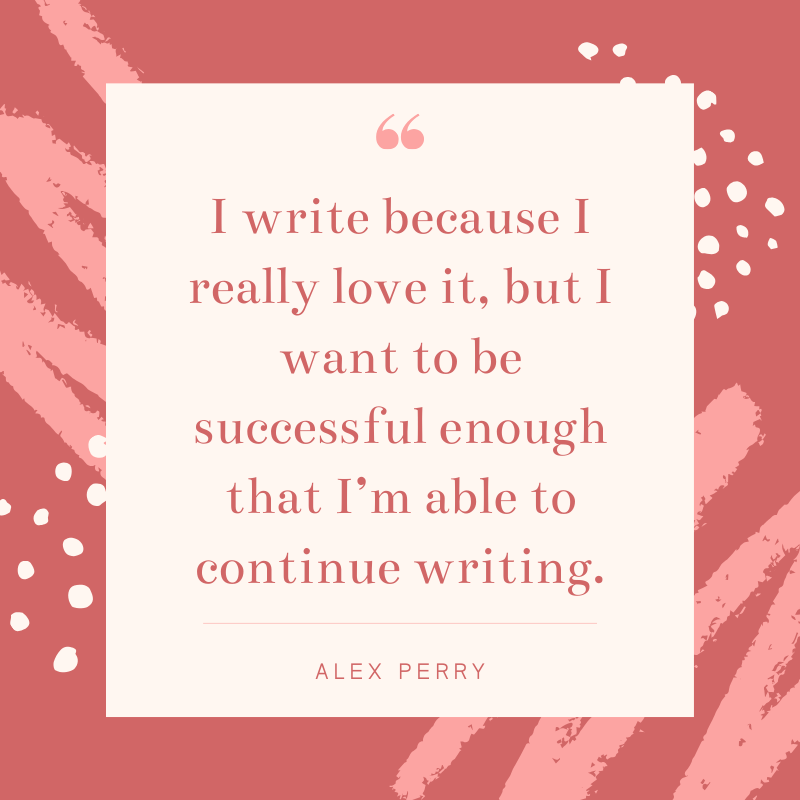
I have a better perspective on the business end of things. I feel like I can see the market a little more clearly and hopefully use that to my advantage. I write because I really love it, but I want to be successful enough that I’m able to continue writing.