YA Author Annie Sullivan on Creating Swag that Works

Most authors will agree that the creative part of the job is where we excel, the business and marketing side, slightly less. It’s lovely when the two can meet in the form of SWAG – Shit We All Generate. I’ve invited some published authors to share with us their secret to swag… little freebies that can sell a book longer after the author is no longer standing in front of a prospective reader. In order to create great swag, you have to be crafty – in more ways than one.

Today’s guest for the SWAG is Annie Sullivan, the author of the young adult novels A Touch of Gold, Tiger Queen, and A Curse of Gold. She lives in Indianapolis, Indiana, and she loves fairytales, everything Jane Austen, and traveling and exploring new cultures. When she’s not off on her own adventures, she’s working as the Senior Copywriter at John Wiley and Sons, Inc. publishing company, having also worked there in Editorial and Publicity roles. She loves to hear from fans, and you can reach her on Twitter and Instagram.
Sullivan .jpg

Finding something that represents your book and hasn’t been played out by a million authors before is difficult. What’s your swag?

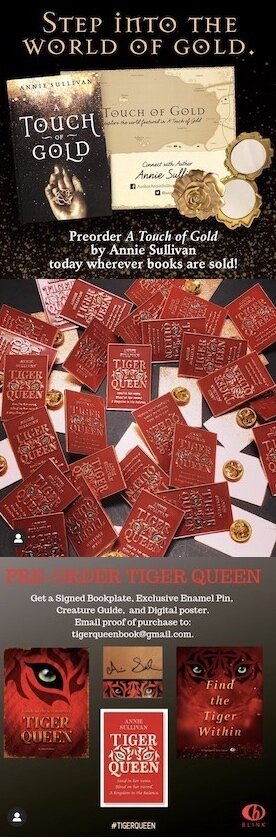
The swag I send out depends on the book. For my first book, A Touch of Gold, I found these amazing gold compact mirrors in the shape of a rose to send out to all those who preordered. It fit perfectly with the golden hand holding a gold rose on the cover of the book. I also did bookmarks, bookplates, and a digital map of the world. 

For my second book, Tiger Queen, I did enamel pins of the book cover that really stood out because of the tiger eyes depicted on them. I will say those pins were hard to mail since I had to wrap them well so they wouldn’t ruin anything else in the package of tear through the envelope. With those, I also sent bookmarks and signed bookplates. Then, I sent a digital poster and guide to the creatures that live in that world digitally. Also, since Tiger Queen is set in a desert that’s running out of water, I also had some custom water bottles made with the book cover and tagline on them. I gave those out at conferences, and they were a big hit.

Finally, for my new novel, A Curse of Gold, I’m leaning toward something that’s easier to send because of the pandemic. So I’m exploring options like character art cards, posters, and digital content.

I always try to do a mix of digital and physical content so that people that like different types of SWAG have something that appeal to them. 

How much money per piece did your swag cost out of pocket?

A lot. I probably paid, including shipping, about $5+ total per person who got SWAG—and way more for international preorders. It was definitely a lot, and while I do typically see high preorder numbers because of it, it’s not something that’s sustainable for multiple books.

Do you find that swag helps you stand out at an event? (or) Does your swag draw people to your table at an event or conference?

For me, SWAG has always been more of a way to incentivize people to preorder my book. But if I have extras, I give them out as prizes at my book launch, conferences, or school visits. Having these items on your table can be a great way to get readers to approach you at an event because you can offer them something for free and then engage them to see what books they like to read.

What do you think of big item swag pieces versus cheaper, yet more easily discarded swag like bookmarks?

Personally, bookmarks always get lost or crushed in my bag as soon as I shove them in there. So while I definitely hand out bookmarks—almost like business cards—I prefer something more substantial that’s not going to be thrown out the second someone gets home from an event. Then again, bigger, more expensive items are harder to ship and cost more. So there’s a lot of give and take in what you decide to use for swag and what you think will resonate with your readers the most.

Sullivan.png

What’s the most clever / best swag by another author?

Personally, I love posters of book covers. They aren’t horribly expensive, and if a reader loves a book or a cover, they’re more likely to display that then something that’s easily lost or wrinkled like a bookmark. For example, I love the Renegades poster I got at BookCon from Marissa Meyer. It’s a fun way to combine character art with book covers.

And the biggest question – do you think swag helps sell books?

Overall, yes. I think it can tip the scales for someone who might be on the fence about getting a book. When they see a cool preorder incentive, that might be the push they need to finally click that buy button. At least, that’s what I hope SWAG does!

Using art therapy to combat addiction, depression, and COVID-19

by Patrick Bailey

Many downers in life try to suck every inch of happiness from our existence. Addiction, depression, and COVID-19 are examples of such emotional vampires. They can cause people to be worried, overwhelmingly sad, bored, and lonely. Furthermore, they can cause a person to try to turn to substances such as drugs and alcohol to alleviate the pain. Art therapy is the perfect alternative to turning to harmful substances for a false sense of happiness. It's a tool that anyone can use to combat the conditions and situations mentioned above. Here's some information about it and how it can help.

What Art Therapy Is All About

Art therapy is a method of treatment that involves the arts. It uses a variety of art forms to help people to work through their pain and struggles. Writing or journaling is a form of art therapy, as are painting and drawing. Other examples of art therapy include writing music, playing a musical instrument, sculpting, sewing, knitting, and crafting collages. Many alcohol and drug rehab centers use art therapy to help patients and clients to work through various stages of addiction recovery. Art therapy is also a practice that some doctors use for neurological conditions such as Parkinson's disease and multiple sclerosis. Alternatively, sometimes art therapy plays a role in the lives of abuse survivors as they are trying to find the way to their true selves and their new lives.

Why Art Therapy Helps

Art therapy can help people for many reasons. The benefits list is long, but we'll mention some of the most crucial ones. First, it allows the participants to create something new and something beautiful. Many people in art therapy programs have been surrounded by ugliness in their environments. The artistic activities allow those people to become creators and take control of their lives by making it what they want it to be.

Artistic activities center a person's focus as well. It can help keep an individual grounded and calm while that person is going through the withdrawal stage of addiction, for example. Additionally, the act of creating art can give a person a strong sense of accomplishment. It can help a person to feel as if his or her life has real meaning, or to help them express their feelings in a more indirect but healing way. That feeling is especially important in someone who is suffering from a depressive episode.

Art therapy could provide a person with a strong sense of who he or she is. Many people discover that they have artistic capabilities while they're in art therapy. They may have spent so much of their lives catering to other people that they never got the opportunity to develop fully. Art therapy gives them a chance to do that.

How to Get Started With Art Therapy

An individual who is interested in art therapy can use several methods to get started. He or she can contact an individual art therapist who can work with the person to use art in its purest form to help combat life's struggles. A person who is working through addiction can contact rehab drug centers to find a facility that participates in art therapy as a part of its overall program. The best way to find out what a facility offers is to contact the facility directly and request to speak to an administrator. Another way to get started with art therapy is to take an art therapy course.

Another way that person can get involved with art therapy is to go it alone. The individual should take a few days to think about which artistic activity is the most appealing to him or her. The individual should then research (if needed) and write down a list of all the materials that will be necessary to perform the activity. For example, the person might need colored pencils and construction paper for a drawing activity. The person can start any time after he or she gathers the appropriate materials. The best way to do it is just to do it. It will be exciting for the individual to see the lovely creation at the end of the activity.

Start Taking Control with Art Therapy

You've just read a brief description of what art therapy is and how it can be of assistance to different people.

Art therapy can be an exciting new way for you to get in touch with your inner artist and use this process of discovery to work through complex emotions. You might want to give it a try if you're in any of the situations mentioned above. Art therapy may also be worth considering if you've tried other therapies and they haven't worked for you. You can use any of the methods mentioned above to start your journey of using art therapy to help yourself. You'll be a lot happier and healthier in the end. Remember, there's no wrong way to recover. The only wrong thing that you can do is to fail to try.

Author Bio: Patrick Bailey is a professional writer mainly in the fields of mental health, addiction, and living in recovery. He attempts to stay on top of the latest news in the addiction and the mental health world and enjoy writing about these topics to break the stigma associated with them. 

Rebecca Kim Wells On Balancing Promotion Versus Writing Time

Today’s guest for the SNOB is Rebecca Kim Wells whose debut novel Shatter the Sky was a New England Book Award Finalist, an Indies Introduce selection, and a Kids’ Indie Next Pick. She is also the author of Storm the Earth (October 2020) and Of Blood and Briars (2021), published by Simon & Schuster Books for Young Readers. She holds a BA in Political Science from UC Berkeley and an MFA in Writing for Children and Young Adults from Simmons College.

Whether you’re under contract or trying to snag another deal, you’re a professional now, with the pressures of a published novelist compounded with the still-present nagging self-doubt of the noobie. How to deal?

 Is it hard to leave behind the first novel and focus on the second?

I think it’s always a little difficult to finally close the door on a book. Shatter the Sky is my debut, so it will always have a special place in my heart. I worked on it for about three years (from the first draft to when it went off to the printer), and I definitely got a little emotional thinking about not working on it anymore. But it wasn’t too devastating—since my second book Storm the Earth is a direct sequel, I didn’t have to say goodbye to the story or the characters. (Now that Storm the Earth is off to the printer, I am getting super sad and scheming ways to return to that world, but that’s another story!)

At what point do you start diverting your energies from promoting your debut and writing / polishing / editing your second?

A lot of people (myself included) don’t realize how much non-writing work is involved in being an author until they’re actually doing it! For Shatter the Sky, I found myself pitching author events, doing interviews, learning basic graphic design, feeling obligated to spend time on Twitter, Instagram, and other social media… Time can get away from you so quickly. 

That being said, I got pretty lucky with timing. I sold Storm the Earth (book two) to my publisher at the end of 2018, after most of the writing work for Shatter the Sky was done. In the spring of 2019, I spent most of my time working on the first draft of the second book. I turned in the first draft of Storm the Earth at the beginning of June 2019, and then had most of June and July to promote Shatter the Sky, which came out at the end of July. Then my editor sent edits back to me toward the end of August, so flipping back to work on the second book came very naturally. Most of the difficult revision and polishing work on Storm the Earth happened last autumn and winter, once I had finished the bulk of my promo work for Shatter the Sky.

The state of the world is vastly different from what it was at this time last year—a lot of things I learned from my experience don’t necessarily apply right now. But one thing I would still say is, whether you are using social media for promo or just to hang out (or both!), try to be intentional when it comes to the amount of time you spend on it. I certainly wasted a lot of time on Twitter because I felt like I “had” to be there, and only had emotional ruts at the end of the day to show for it. 

Your first book landed an agent and an editor, and hopefully some fans. Who are you writing the second one for? Them, or yourself?

I’m so grateful for the people who have read and loved Shatter the Sky, and I appreciate all the readers who have taken the time to tell me how much they enjoyed it. That being said, ultimately, I have to write for myself. Obviously I want readers to be happy—that’s what books are all about! But I’ve learned over the years that I can’t really make progress in my work unless I tune out outside voices completely and try to focus only on what is right for the story I’m telling. I do the best I can, and all I can hope for is that readers find the same satisfaction in reading my books as I aim for while writing them.

Is there a new balance of time management to address once you’re a professional author?

Absolutely! I touched a little on this while talking about switching between promotion for Shatter the Sky and the work of writing Storm the Earth, but it bears repeating and elaborating: If you are an author, especially if you are writing one book per year, your responsibilities are going to overlap and exponentially increase as promotional work comes into play. I’m not sure what I would have done if the timing hadn’t worked out such that I could mostly trade off the writing and promoting work. For anyone gearing up to do this, I would suggest making a promo/marketing schedule for yourself—perhaps set aside one day per week to take care of email pitches, interviews, designing graphics, scheduling Instagram posts, etc. Then (ideally) you’ll be done and you won’t have to worry about it while you’re writing! 

What did you do differently the second time around, with the perspective of a published author?

Okay, so…I would say that these are more things I intend to do differently this time around—we’ll see if I actually can keep those promises!

Wells.png

I want to spend less time on social media, honestly. I do find value in it, but it stresses me out so easily and can really cast a pall over the rest of my day. I’m going to try to schedule my social media time and not exceed it.

At the same time, the bulk of my promo work will likely be online for the next…while. I’m planning to go to a craft store and stock up on a few pretty fabrics and knick-knacks for photo shoots. (Keep the receipts to write off of taxes!) I’ve been making do with what I have around the house, but there are some people on Instagram who have gorgeous feeds, and it pays off. I’m moving soon, and I also plan to stage a bookshelf to use as a background for virtual events or shooting videos.

This is something I have been doing: For those intending to do author appearances or readings (virtual or otherwise), I’d recommend attending a few events and taking notes on what worked for you and what didn’t. Preparing for events makes them way less stressful. 

And lastly, I’m spending more time supporting other books and authors I love—buying books, checking books out from the library, retweeting them, commenting on/liking posts, shouting about them online, signing up for newsletters, posting reviews and pictures… Publishing and authoring is a very odd business to be in, and kindness and enthusiasm go a long way.