
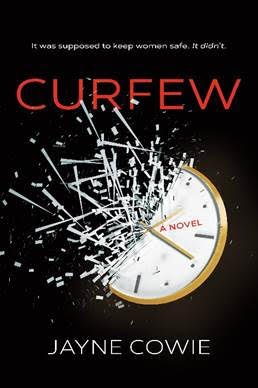
In near-future England, a strictly enforced curfew was the only option. At least, that’s what seventeen-year-old Cass learns in school. As women suffered increasing levels of violence at the hands of men, the courts took action – and legalized a society in which men would be traced and their movements restricted at night. Cass hates curfew because it limits kind men, like her best friend, Billy. Billy would never hurt anyone, and Cass wants to find a way to prove it… somehow.
Helen, Cass’s teacher, is secretly desperate for a baby, and she knows her boyfriend Tom is a good man, but part of the curfew mandate stipulates that a couple wanting to move in together must first submit an application and participate in a series of interviews with a therapist. She is terrified that their application won’t be approved.
But Cass’s mother, Sarah, owes her livelihood to the curfew. She works at a tagging center and is grateful for the harsh penalties levied against her ex-husband, Greg, who has been imprisoned for breaking curfew. When Sarah learns that his release is imminent, she’s scared, but knows that the curfew will protect her and Cass.
After all, the curfew was created to protect women from men. And it has – until now. When a woman’s body is discovered in a local park, all bets are off. A woman couldn’t have committed this heinous crime – and the curfew means that any man who tried would have been caught…right?
Curfew imagines a world where men are the restricted ones -- women no longer have to fear walking home alone in the dark, because men aren't allowed out. What led you to this idea, and how do you think it would play out in the real world?
There were a few things that brought me to Curfew – I should start by saying that the book was originally written back in 2019, pre-Covid, when we were in the old normal and the idea of any sort of lockdown or restriction seemed impossible. We were in the aftermath of #MeToo, when we’d seen a small number of high-profile men toppled from their positions of power. It had been a while since we’d had much public debate about women’s rights but all of a sudden it seemed like everyone was talking about it.
I wasn’t convinced that we would actually see changes. It looked to me like a few men were being sacrificed in order to let the rest carry on as usual, like a cheating husband buying his wife a bunch of red roses and a gold necklace in order to sweeten her up, when in reality he has no intention of changing his ways at all. He just wants her to stop pointing out his bad behaviour and go back to washing his pants.
I began to wonder what we would do if we really took male violence seriously, if we stopped talking about violence as a thing done to women and started instead to talk about it as a thing that men do. How would we stop it? Can we stop it? What would it take? My starting point was female safety in public places, something which is often talked about in the media, hence the idea of the curfew. Every violent act is dependent on access to the preferred type of victim. Take that access away and the violence can’t happen. That’s what the curfew does.
Your novel views such a drastic move from both sides -- some people think the curfew is just and fair, while others believe that it imposes harsh restrictions on "good men" who have no history of violence. Was it difficult to imagine arguments from both sides of the fence for the purposes of the novel?
I knew as soon as I began to imagine the world of curfew that there would be arguments for both sides. It does restrict men with no history of violence. There’s no denying that. Some people would argue that’s unfair on good men, but others might argue that a good man is only a violent man who has so far managed to control himself. When the suffragettes campaigned for the right to vote, there were those who disagreed with them, including some other women. There were fears about what it would do to the order of society, to employment, to the role of men, and what else might be asked for if the right to vote was granted.
I felt the same would happen with a curfew. A single mother with sons would have a very different experience to a single mother with daughters. Families reliant on the wages of men who do work that would normally require them to be out of the house during curfew would find the restrictions very difficult. It’s a matter of empathy, I suppose, of understanding that everyone would have their own unique experience of life with curfew, some good, some bad. My aim, when writing the novel, wasn’t to suggest that a curfew like this is a solution to male violence, or even a good idea, but to explore the impacts of restricting men in this way.
Quite a few British novels have recently explored social-sexual inequality, like The Power by Naomi Alderman and The End of Men by Christina Sweeney-Baird. What do you think has driven this interest?
I think that every generation of young women has a moment when they realise that sexism and misogyny still exist and the battle for women’s rights has not yet been won. When girls are at school, they are told that they can do and be anything, but when they become adults, they find themselves trying to navigate a world which won’t let them. We’ve made a lot of progress, it’s true. But the gender pay gap still exists and isn’t getting any smaller. We’ve got a healthcare gap, too; it takes on average eight years to get a diagnosis for endometriosis, for example, and pain relief options for childbirth haven’t improved in years.

Women are asked what they were wearing, how much they’d had to drink, what they did to make a man act in a violent way. Women are expected to work like they don’t have children and mother like they don’t have to work. We don’t have the promised equality of opportunity, as you will know if you’ve ever queued for the toilet during the interval at a theatre whilst men stand around chatting at the bar. I also think that the internet has a role to play; men have embraced the opportunity to spill their darkest thoughts about women without fear of repercussion. Whilst smartphones and social media have brought us many positives, they’ve also brought us upskirting, revenge porn, cyberflashing and a torrent of misogynistic abuse which some sites insist doesn’t break their rules. So it’s no wonder that women are interested in what it would be like to flip the script and hold the power, or that we’re writing about it.
What's up next for you, as a novelist?
At the moment I’m working on my next book, which asks what would happen if we identified a genetic cause for male violence. I suppose you could say that it’s the natural next step after Curfew . The story follows two sisters who give birth to baby boys only a few months apart. One of the sisters has her son tested for the gene, and one doesn’t, something which seems like an inconsequential choice at the time. But as the boys grow up, the decisions their mothers made for them have consequences for every aspect of their lives as society changes as a result of the newfound ability to classify men as good or bad before they do anything wrong.
An avid reader and life-long writer, Jayne Cowie also enjoys digging in her garden and makes an excellent devil's food cake. She lives near London with her family. You can find her on Instagram as @CowieJayne
