Geralyn Ritter on Accessing Personal Trauma In Memoir

Inspiration is a funny thing. It can come to us like a lightning bolt, through the lyrics of a song, or in the fog of a dream. Ask any writer where their stories come from and you’ll get a myriad of answers, and in that vein I created the WHAT (What the Hell Are you Thinking?) interview. 

Today’s guest for the WHAT is Geralyn RItter, the author of a memoir about her recovery from the 2015 Amtrak derailment titled, Bone by Bone: A Memoir of Trauma and Healing.

Ideas for our books can come from just about anywhere, and sometimes even we can’t pinpoint exactly how or why. Did you have a specific origin point for your book?

Yes.  The origin point was rather dramatic – a trainwreck. I was returning home from an ordinary business trip on an ordinary day. Amtrak 188 derailed outside of Philadelphia going 106 mph on a curve designed for a maximum of 50 mph. Eight people lost their lives, and my injuries were so extensive, I was not expected to live. My family flew into town immediately, and one of my brothers packed a dark suit for my funeral.

The extraordinary experience of being a “polytrauma” patient and survivor has been a defining element of my life since the accident in 2015.  I was given the gift of a second chance at life, and the only way I knew to ‘pay forward’ that gift was by sharing in a book some of the things I learned on my journey (and wished I had known at the beginning).

Once the original concept existed, how did you build a plot around it?

Many memoirs start by introducing the author, but I felt strongly about starting with the accident.  The real need that I wanted to fill with this book was not about how I survived, but rather about how I reclaimed my body and my life and embraced a different version of the future.  The chaos, stress, blood and tears of that night and my family’s frantic 9-hour search to find me set the stage.  The plot unfolded naturally from there – the joy and gratitude that I had survived, the wildly unrealistic expectations I had for my recovery, my emotional freefall as I came to understand the reality, the impact on my family, and the slow walk back to a life filled with purpose and joy.  

Have you ever had the plot firmly in place, only to find it changing as the story moved from your mind to paper?

Yes.  As I wrote, I learned.  I read and researched so many topics: physical trauma and mental health, pain and opioid dependence, the impact of trauma on caregivers and on children, the challenges of returning to the workplace after a long absence, and more.  I interviewed some of those around me who could fill in gaps in my memory and describe events that happened when I was unconscious.  I also thought deeply about my faith and worked to make sense of the accident and my survival.  This process gave the plot a depth that was initially missing.  It led me to emphasize parts of the story that I had initially dismissed as less significant --  and hopefully also made the book a more valuable resource for other survivors.

Do story ideas come to you often, or is fresh material hard to come by?

Story ideas come to me often.  I work in global women health and have had the privilege to meet amazing strong women from diverse circumstances and backgrounds around the world.  I have often regretted that their stories are not told, and their voices are rarely heard.  I believe in the power of storytelling to create change.  That is why when I faced my own unexpected and searing experience, I felt that I had to write about it.

How do you choose which story to write next, if you’ve got more than one percolating?

I plan to continue to write non-fiction related to resilience, health and gender equity and women’s leadership.  I haven’t decided on the story because there are so many possibilities.  I need to digest feedback from Bone by Bone: A Memoir of Trauma and Healing and think more about how these stories can make a difference.

I have 6 cats and a Dalmatian (seriously, check my Instagram feed) and I usually have at least one or two snuggling with me when I write. Do you have a writing buddy, or do you find it distracting?  

My two dogs!  They are adorable but we did a terrible job training them.  They are not allowed upstairs except to stay with me in my office when I am working.  They sleep at my feet, keep me company, and when they need a break, I usually do too!

A recognized expert in healthcare policy, Geralyn RItter is executive vice president at Organon & Co., a new Fortune 500 healthcare company dedicated to the health of women. She was formerly senior vice-president at Merck & Co., Inc., one of the largest pharmaceutical companies in the world. She has spearheaded global government affairs and policy, led initiatives on corporate governance and corporate responsibility, created and launched a widely acclaimed half-billion-dollar philanthropic initiative to end preventable maternal deaths around the globe, and served as President of the Merck Foundation. In 2020, on behalf of Merck, Geralyn accepted the Disability Employer of the Year award.

Lauren Ho On The Pressures of the Sophomore Novel

We all like to hear about the journey to publication, and hopefully other people's success stories help bolster the confidence of those still slogging through the query trenches. But what happens after that first book deal? When the honeymoon is over, you end up back where you were - sitting in front of a blank Word document with shaky hands. Except this time, there are expectations hanging over you. With this in mind, I’ve created the SNOB (Second Novel Omnipresent Blues) interview.

Today’s guest for the SNOB is Lauren Ho , author of Lucie Yi Is Not a Romantic, which released June 21st.

Whether you’re under contract or trying to snag another deal, you’re a professional now, with the pressures of a published novelist compounded with the still-present nagging self-doubt of the noobie. How to deal?

It’s true that most second-time novelists like myself are still new to the publishing industry, especially those of us living outside of the US/UK who’d never gone through the MFA route and lack the built-in support networks that such authors have. Publishing is an opaque industry, and what’s been helpful for me at least is Book Twitter, which demystifies parts of it and tells you what is within your control (write a fine book) and what is without (marketing, publicity) as an author. I just work on bettering my craft and let others handle the other aspects of publishing, and that’s been immensely freeing.

Whenever I feel burnt out, or need support, I turn to my 2020 debut authors peer group. We’ve been through a lot as the worst of the pandemic debuts, and we support each other as much as we can. I’ve also made friends with more experienced authors who’ve passed on some very important tips to me. All this to say that it takes a village to survive being a published author!

Is it hard to leave behind the first novel and focus on the second?

In a sense, yes, because my debut novel, Last Tang Standing (LTS), was published during the bleakest months of early pandemic, and having not had the “classic” trad-pub debut experience (events at bookstores and meeting readers) that most authors dream of, I do sometimes find myself wondering what could have been if I’d debuted in 2019!

For my second novel, Lucie Yi Is Not a Romantic., because I didn’t have a two-book deal and I sold it well into the year after LTS was published, I feel like in terms of the writing I was able to really focus on it without being distracted by promotional stuff for LTS. Also, I’m more of a plotter than a pantser now, and I’ve improved my craft, which makes writing much speedier with less detours.

At what point do you start diverting your energies from promoting your debut and writing / polishing / editing your second? 

I started writing Lucie Yi almost half a year after I debuted, sold it on option with a few chapters, before proceeding to frantically complete it my manuscript in six months including revisions. In that time I had some emotional distance and head space to work on Lucie Yi without being encumbered by promotional work for LTS. That really helped!

Your first book landed an agent and an editor, and hopefully some fans. Who are you writing the second one for? Them, or yourself?

For my second book, I wrote in a different style from my second book, even though it’s still in the general adult/women’s fiction/romcom category crossover genre. You could say stylistically and tonally, Lucie Yi is a more “serious” read because of some of its themes (pregnancy loss, fertility, infidelity). I wanted to tell a story about a South-East Asian woman in her late thirties who wanted a child, and gets pregnant during the course of the novel, which isn’t something you see in a lot of romances.

I did however want to satisfy those readers who fell in love with the voicey, funny writing in LTS (which landed 3 starred reviews and was on several ‘best of’ lists), so Lucie Yi is still very much a voicey, funny book, in spite of its themes. And for those who liked the cultural setting and familial clashes in LTS, Lucie Yi retains both elements.

Is there a new balance of time management to address once you’re a professional author?

Well I now have two kids since LTS published, and a day job again, so I guess I have even less time than I did before to write, but I’m taking it one step at a time. I believe in writing when you can, and not fussing too much with the first draft. Just keep writing until you have a manuscript, then you can start editing/polishing the crap out of your first draft.

What did you do differently the second time around, with the perspective of a published author?

I tried to get my sensitivity readers involved more extensively than I did for LTS, because I think as a South-East Asian writer writing in English, I bear a heavier burden of representation and I do want to live up to it as much as I can without letting it overwhelm the creative process and the story I want to tell.

I have also learned how to create healthier boundaries on how I use social media as an author. I am a private individual by nature and I’ve learned how to negotiate the space better since LTS was published. I have also made peace with the fact that some people are just malicious/negative online personas, and since I can’t change how they act, I need to preserve my sanity and protect my mental health and decide on how I want to engage with personal attacks.

Still, in general I’m really happy with the amount of love that my books have gotten, not just at home (Malaysia and Singapore), but with a global audience, and I continue to be grateful for the opportunity to share my stories with readers from around the world.

Lauren Ho is a reformed legal counsel who now prefers to write for pleasure. Hailing from Malaysia, she is currently based in Singapore, where she’s ostensibly working on her next novel while attempting to parent. She is also the author of the international bestseller, Last Tang Standing. Her mother still wishes Lauren had gone to medical school, though. Find her on Instagram and Twitter at @HelloLaurenHo.

Liisa Jorgensen on Writing A Real Life Love Story

Inspiration is a funny thing. It can come to us like a lightning bolt, through the lyrics of a song, or in the fog of a dream. Ask any writer where their stories come from and you’ll get a myriad of answers, and in that vein I created the WHAT (What the Hell Are you Thinking?) interview. Always including in the WHAT is one random question to really dig down into the interviewees mind, and probably supply some illumination into my own as well.

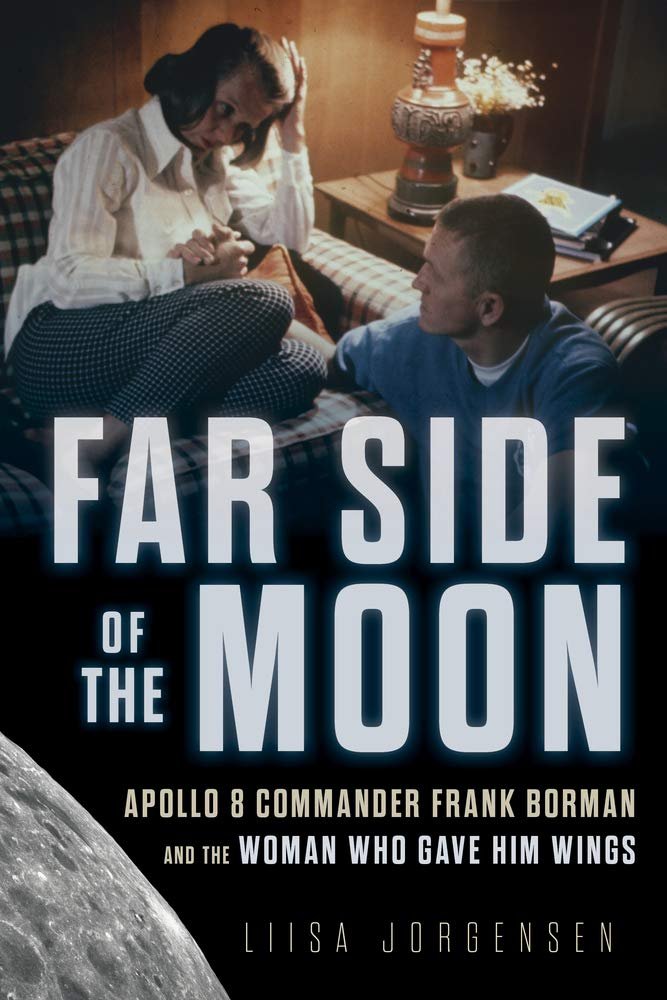
Today’s guest for the WHAT is Liisa Jorgensen, the author of Far Side of the Moon: Apollo 8 Commander Frank Borman and the Woman Who Gave Him Wings, the decades-long love story of a NASA commander and the leader of the Astronaut Wives Club.

Ideas for our books can come from just about anywhere, and sometimes even we can’t pinpoint exactly how or why. Did you have a specific origin point for your book?

I have worked as a story editor and production manager for an Emmy award winning film company for the last 20 years. We are always looking for unbelievable non-fiction stories, and I felt on a gut level that I found that when I came across Frank and Susan’s beautiful story. There have been many books written about the Apollo space program, but not through the eyes of the women and children that were experiencing it in a different way. I wanted to be the one to do that. 

Once the original concept existed, how did you build a plot around it?

Because the book is non-fiction, the plot is essentially there. The challenge for me was to write it in a way that was accessible and engaging without getting up on a soapbox.

One of the reasons I was so passionate about writing Frank and Susan Borman’s story from Susan’s perspective is because I felt that she, along with all the other astronaut wives hadn’t been represented in the way I felt they should be. I related the most to Susan and couldn’t imagine how internally strong she had to be to hide her mental illness from everyone, because she truly had no choice. There was no one to talk to, and the shame that came with admitting something like that in the intense environment at NASA she lived with daily would eventually lead to her breakdown.

Have you ever had the plot firmly in place, only to find it changing as the story moved from your mind to paper?

I had to get Frank and Susan’s support to begin with, and when I got the green light on that I dived into the research. Because of that relationship and the doors that it opened, I was able to interview and speak candidly with the astronaut wives that are still with us. It was a privilege to talk to these amazing women. The idea never changed. I knew the story I wanted to tell.

Do story ideas come to you often, or is fresh material hard to come by?

Good writing is good storytelling conveyed in a way that is relevant to a variety of readers. I feel that one of the most difficult parts of starting the process to write a book is finding a story that will both inspire and help us become better humans. I tend to look for stories about strong women who have overcome immense challenges and have been over-shadowed by the men or circumstances in their lives.  I also believe that a personal connection to what you are writing will keep you moving through the blocks, and those moments you want to quit.  

How do you choose which story to write next, if you’ve got more than one percolating?

It must check all the boxes: an active human quest, emotional stakes that are very high along with trials and obstacles to overcome. The challenge for me as a non-fiction writer is that I can’t manufacture that, so it is a treasure hunt to find a story that meets each one of those metrics.

I have 6 cats and a Dalmatian (seriously, check my Instagram feed) and I usually have at least one or two snuggling with me when I write. Do you have a writing buddy, or do you find it distracting?

I absolutely do! She is sitting beside me right now as I am writing this. She is an adorable bichon/poodle and was born the day my book came out – December 7, 2021.

I named her SuSu, which is what Susan’s grandchildren called her, and Frank named every plane he owned SuSu as well. I have always loved animals and could not imagine my life without them.

Liisa Jorgensen has worked as a writer and story editor on a diverse variety of film and television productions for Myth Merchant Films for over 20 years. She believes in the power of story and its ability to help audiences transform and become better humans. She is especially interested in ending the stigmas associated with mental illness and disorders, as well as highlighting those who serve a greater good and live for something other than themselves. She lives in Edmonton, Alberta, Canada.