Jennifer Salvato Doktorski On Making Swag You Can Legally Mail

Most authors will agree that the creative part of the job is where we excel, the business and marketing side, slightly less. It’s lovely when the two can meet in the form of SWAG – Shit We All Generate. I’ve invited some published authors to share with us their secret to swag… little freebies that can sell a book longer after the author is no longer standing in front of a prospective reader. In order to create great swag, you have to be crafty – in more ways than one.

15802883.jpg

Today's guest for the SWAG is Jen Dokstorski, who has held various jobs such as speech writer, bank teller, ghostwriter, bookkeeper in a lampshade factory, pet shop clerk, and music zine editor. At one point in her life she wrote obituaries for eight months. Her YA books HOW MY SUMMER WENT UP IN FLAMES and FAMOUS LAST WORDS were released in 2013. Her recent release, THE SUMMER AFTER YOU AND ME was published in May 2015 by Sourcebooks Fire.

Finding something that represents your book and hasn’t been played out by a million authors before is difficult. What’s your swag? 

So true! It’s not easy to be original. For my first YA novel, HOW MY SUMMER WENT UP IN FLAMES, I wanted to get custom-made matchbooks with the book’s cover on one side and my website on the other. However, my publicist warned me that mailing those might be an issue, so I wound up ordering pens that look like matchsticks. My second YA novel, FAMOUS LAST WORDS, was about a girl who gets a summer job writing obits at local newspaper. For that book, I purchased official reporters notebooks to include with giveaways.

How much money per piece did your swag cost out of pocket?

The pens were $.79 each at Office Playground. I ordered 100 and I still have three left. The reporters notebooks came in a 12-pack for $18.75.

matchstick.jpg

Do you find that swag helps you stand out at an event? 

The pens gave me something to talk about because people didn’t know what they were at first. I always got a laugh when I clicked the top and showed people it was a pen. Ultimately, I think cool posters attract more attention than swag does. I had posters made for each of my books.

What do you think of big item swag pieces versus cheaper, yet more easily discarded swag like bookmarks? 

I think big item swag pieces can be fun to include with giveaways, but may not be very practical or effective for widespread distribution. I’ve made up tote bags with my book covers on either side and this past summer, I teamed up with two author friends, J. Albert Mann and Bethany Crandell, who also had summer releases. Bethany is the author of SUMMER ON THE SHORT BUS and Jen Mann is the author of the Sunny Sweet middle grade series and the forthcoming YA historical novel SCAR. We held a giveaway for all three of our books and had a charm bracelet created to include with the prize package. I wound up liking it so much I had one made for myself! 
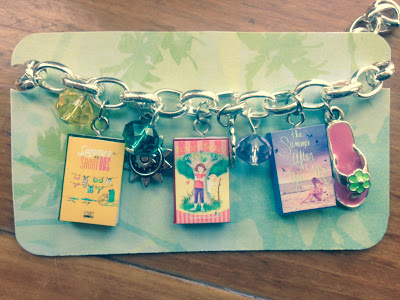
bracelet.jpg

What’s the most clever / best swag by another author? 

This isn’t swag so much as a promotional item, but the aforementioned Jen Mann, had giant decals made depicting the cover of SUNNY SWEET IS SO NO SORRY and turned her car into the Sunnymobile! Adorable and attention-grabbing.

And the biggest question – do you think swag helps sell books? 

Sigh. I honestly don’t believe swag helps sell books, but it can be so much fun to hand out! Bookmarks seem boring, I know, but I believe they’re a great way to get your name out there. I’ve dropped them off at libraries in my area, mailed them to libraries in other states, and handed them out to random strangers when they’ve asked me about my books. My latest YA novel, THE SUMMER AFTER YOU & ME is set at the Jersey shore and a lot of local businesses were willing to keep my bookmarks on the counter by the cash register.

The Wide, Wide, World of Reality

People often ask me what it's like inside my head.

The honest answer is that it's the Beetlejuice soundtrack in there, and it's easy to get lost.

I'm an outdoors person, and an athlete. I try to run, or get my daily dose of sunshine in (even when it's cloudy, those rays get through!) regardless of the workload. It helps keep me connected with the real world, to humanity in general, keeps depression at bay, and also keeps my ass at a manageable size.

The boyfriend is an outdoors-y guy as well as a creative, (I've said before- think a Thoreau/Daryl Dixon mashup with a photography degree), and his view of the world always amazes me. I can make up shit in my head all day long and sell it to you, convince you to care about things that never happened to people that don't exist. But he can look at something mundane and see the amazing, capture the magical qualities of a corn stubble field in the snow that I never knew existed.

I've lived around cornfields my whole life, and yes, I've always known there was something a little eerie about the stalks - green or dry - rubbing against each other in the wind. They have their own special sounds, they can slice your skin like paper, and if you wander more than four rows in you WILL get lost. Sometimes for a good long while.

But I've never thought about the stubble, the mowed off, unproductive sentinels that simply wait six months to get plowed under. They're distinctly unmusical. A remnant. Until my boyfriend went out yesterday and took some shots that make them look like a tiny invading alien army wading through the snow to come kill us.

I think as writers we sometimes spend too much time in our heads, neglecting the world around us, and the amazing qualities even the most mundane objects can hold if we change our perspective. So think about it today as you go about your routine - oh, yes, the routine, that will make you blind to everything except the task in front of you.

Make your desk chair a little higher, or a little lower. Take a pen and put yourself on eye level with it and really look at it for second. Find something you see every single day, and look at it a different way.

You'll see something new.

Pat Zietlow Miller On Inspiration

Inspiration is a funny thing. It can come to us like a lightning bolt, through the lyrics of a song, or in the fog of a dream. Ask any writer where their stories come from and you’ll get a myriad of answers, and in that vein I created the WHAT (What the Hell Are you Thinking?) interview. Always including in the WHAT is one random question to really dig down into the interviewees’ mind, and probably supply some illumination into my own, as well.

25777449.jpg

Today's guest for the WHAT is Pat Zietlow Miller, who has four picture books in print and six more on the way! Her debut, SOPHIE’ S SQUASH, won the Golden Kite Award for best picture book text, an Ezra Jack Keats New Writer Honor and a Charlotte Zolotow Honor. It also won the Midwest Region Crystal Kite Award and was a Cybils’ finalist. Her newest, THE QUICKEST KID IN CLARKSVILLE releases today from Chronicle!

Ideas for our books can come from just about anywhere, and sometimes we can’t pinpoint exactly how or why. Did you have a specific origin point for your book?

My new book, THE QUICKEST KID IN CLARKSVILLE, had two specific points of origin. I started writing the story because I had read the wonderful picture book THE NEW GIRL … AND ME by Jacqui Robbins and Matt Phelan. It was so amazing that I really wanted to see if I could write something anywhere near as good. So I started writing my own friendship story featuring two girls – Alta and Charmaine – who both wanted to be the fastest kid on their block.

The resulting story was perfectly fine, but not particularly noteworthy. I set the story aside and it didn’t take out again until I attended the Rutgers One-on-One Plus Conference and talked with Random House editor Chelsea Eberly. She suggested adding a historical element. The second she did, I know just what I was going to do.

That’s how Olympic gold-medal-winning sprinter Wilma Rudolph joined the story. She gave my girls a common hero and gave the story a specific setting – 1960 Clarksville, Tennessee.  The story wouldn’t be what it is today without those two pivotal moments.

Once the original concept existed, how did you build a plot around it?

When I researched Wilma Rudolph, I learned she was more than the fastest woman in the world. I learned she’d overcome physical and economic challenges to earn her success and that she’d played an important part in integrating her hometown. I worked those elements into my manuscript, as well.

The story’s basic plot stayed the same, although I changed how the girls competed to see who was faster so that their challenges were loosely based on Wilma’s three Olympic events. And, I made Wilma’s real-life welcome-home parade the final event in the story where Alta and Charmaine realize they can be friends instead of competitors.

Have you ever had the plot firmly in place, only to find it changing as the story moved from your mind to paper?

My drafting usually goes one of two ways. 

1. My first draft is exactly what I had in my mind as it moves from my head to the paper because I had it fairly well thought out before I started. Of course, then it changes when as I think about it further and share it with my writing friends.

2. My first draft is nothing like what I had in mind because I started out with only a few words or a fragment of an idea and I figured it out as I typed. Stories that start this way also usually go through a lot of changes as I revise.

Do story ideas come to you often, or is fresh material hard to come by?

I almost hate to say this, because I don’t want to tempt fate, but I get a lot of ideas. Those don’t always turn into things that are worthwhile, but I’m constantly noticing things odd, interesting or unusual things and pondering how I might be able to turn them into a story.

I think writers tend to notice stuff other people look past. My husband is a sports reporter, and I remember accompanying him to a high school basketball game. He was evaluating the players and analyzing the defense and tracking points and rebounds. I played basketball, so I understand the game, but my big takeaway was the cool socks one team was wearing. I think that says a lot about how I think.

I wrote a blog post about where writers get ideas that you can see on Tara Lazar’s Picture Book Idea Month blog. Spoiler: It mentions rolling grapes.

How do you choose which story to write next, if you’ve got more than one percolating?

I go with whichever idea I’m most excited about at the time. Usually, there’s one that I just can’t stop thinking about. So I follow that one until I’ve exhausted all its possibilities. 

I usually have several manuscripts in various stages at any one time. But, one of those is always the primary manuscript and I only work on the others when I’m stuck on the primary one or when it needs to rest for a bit.

Sometimes the perfect word eludes me. If I can’t come up with it in the moment I usually write something in ALL CAPS like A GREAT WORD HERE and move on to catch it later in revision. Do you roll with the flow, or go find that word right away?

My preference is to find the right word or phrase at the moment I’m writing. I’m kind of compulsive that way. But although that’s what I want to do, it’s not always the best thing to do. So I often put notes in manuscript saying things like: “ADD SOMETHING FUNNY HERE.” 

That captures my ultimate plan for the manuscript, lets me keep going without losing momentum and lets whatever I need to eventually add simmer on my brain’s back burner for a while. And, eventually, the perfect thing bubbles to the top.