

Today's guest is Lucinda Halpern of Lucinda Literary, whose strong background in marketing and broad media and film relationships enable us the firm to be strategists and advocates not just for books, but for the long-term careers of their authors. Lucinda joined me to talk about common query mistakes, and marketing tips for authors.
My Wonderful, Interesting, Not So Special Life
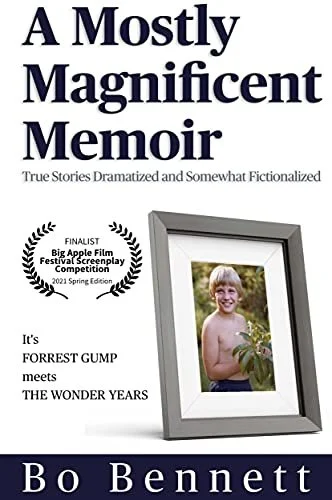
by Bo Bonnet, PhD, Author of A Mostly Magnificent Memoir: True Stories Dramatized and Somewhat Fictionalized
In the 1990's, Jerry Seinfeld had a smash hit TV show about "nothin'." This was the pitch... it was a show about nothing. Actually, the show was about four of the most entertaining characters of all time, navigating their mundane lives in a hilarious way. None of the characters were saving the world. None of them suffered through any horrific life event and came out stronger. None of the characters did anything remarkable. It is not about what they did or did not do, but how they did it. It was this idea that inspired me to write my story. I would write it to be factually accurate, but in a way that made it entertaining to read. In a sense, this is the art of storytelling.
Now that I convinced myself that even the story of a "regular guy" could be told in an interesting and entertaining way, I realized that many of my stories were far from mundane, normal, or about "nothing." It was just a matter of taking a trip down memory lane and jotting down notes on all these stories, then deciding which could be told in a way that would be interesting and entertaining to someone who doesn't know me. I chose the stories, then started writing... and writing... and writing.
Being only 45 years old, my life story is far from complete. I realize this, so I chose to write about the first 25 years of my life only—at least in this book. I think many people might hold off on writing their life story because there is much more to be told. Even if we don't get hit by a bus tomorrow, we never know when the last chapter will be metaphorically written, so it's best to literally write as many chapters as we can now. That's exactly what I did.
Writing Your Story
Your story is worth telling. If you go back through your life, I am sure you can recall many interesting events. Now, share those events in an interesting and entertaining way. The elements of good storytelling are beyond the scope of this post, but there are many online resources that can help you with this. But here are some tips:
What are the stories you tell to others who seemed to be entertained by them?
How can you add humor to them?
How can you add an emotional component?
How can you add suspense?
What visual elements can you include?
How can you end the book so the readers feel a sense of closure?
Thanks to modern publishing, you can always update your book and add chapters on a regular basis. I plan on adding a few chapters every year to mine.
The bottom line is, write your story. Your friends and family want to read it, and if you write well, strangers will want to read it too. No, your life's not over yet, but if everyone waited until they were dead to write their life story, there would be no autobiographies.
The Space in Between: An Empath’s Field Guide
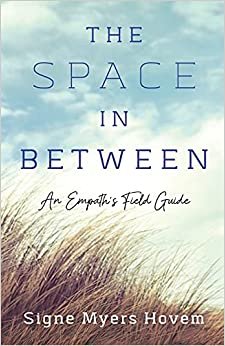
by Signe Myers Hovem
One of the blurbs offered for my book The Space in Between: An Empath’s Field Guide generously states that I “put words to the wordless,” which honestly, was the most gratifying praise I could have received. It also partly explains why it took me so long to write my book—nearly ten years of countless revisions, exploring how to articulate my intuitive sensory existence.
For many empathic persons the world can be confusing and isolating; particularly for those who are unaware that they receive extrasensory information from the environment and unwittingly accept what they feel as their own. Or for those who are aware that they are empathic, yet feel a disconnect due to a lack of definition and understanding of what that means within society. Most dictionaries, in fact, place the origin of “empath” in science fiction and fantasy, which hints at the difficulties people with such sensitivities and abilities face in communicating how they experience the world.
How do you validate your sensory experiences of feeling emotions, thoughts, and physical discomfort of others when even the dictionary—the authority on language—only affords you an existence in science fiction or fantasy?
The effort of giving language, and thus form, to the nebulous-yet-visceral experiences of an empath undeniably challenged me. My intention throughout my writing process was to demystify the empathic experience for anyone, empath or not, and that meant I needed a way to let the reader into my world. The irony is not lost on me that “world building” is typically a task for fantasy and science fiction writers and not one for a nonfiction writer describing the physical world we all inhabit in the here and now.
And there’s the rub; empathic or not, we don’t all inhabit the same view or perception of the world. Once I recognized that the dictionary’s definition of an empath revealed more about the collective mainstream beliefs and biases than what an empath was, beyond labeling it a paranormal ability, my book’s structure emerged, as did my sense of purpose. I would be a guide to the reader, supported by ancient Greek poet Pindar’s prompt, which has been my personal touchstone and is quoted in the early pages of my book: “Learn who you are and be such.”
How do we, as individuals, learn who we are? From an early age we are told who we are, or who we should be, by our family and our society. Though this telling may be more about safeguards than outright intentional suppression, this standardized approach to life influences the collective perception of what’s true and possible within human experience. Any person who envisions or experiences a contrary reality to the mainstream version will undoubtedly be pushed to question personal truths. At the very least, they will be challenged to be authentic in a world of conformity.

Self-awareness and acceptance are pivotal mindsets that, once embodied, open life up to self-actualization and authenticity. For an empath, that journey involves an evolutionary arc from being an overly sensitive person trying to survive in their environment by feeling separate, to becoming an engaged and functional empath who witnesses what’s out of balance and honors that connection. Along this arc is gaining the understanding that the physical world is an energetic expression. Intuition’s wheelhouse is the ability to sense the energetic realm, which is how an empath can sense others’ displaced and unprocessed emotions, thoughts and physical discomfort.
Writing The Space in Between: An Empath’s Field Guide , I needed readers to grasp a unified sensory system that includes intuition—while removing the science fiction and fantasy bias. To build awareness of our relationship to the energetic world, I created field guides for five different landscapes: The Field of Reflection, The Field of Definition, The Field of Sensing, The Field of Experience and Awareness, and the Field of Mystery. Each of these fields provided me with insight and movement in my own journey toward a balanced perception of the world and my place in it as an empathic person, wired for extrasensory reception and connection.
I hope readers, empath or not, will embrace the inherent wisdom offered by an empathic nature: the fundamental truth that we are sensory, energetic, creative, and multi-dimensional beings; and we are all connected.
The Space in Between: An Empath’s Field Guide offers questions for reflection at the end of each chapter, inviting the reader to understand their own sensitivities, their own capacity to care for themselves and others, and to embrace the larger conversation their sensory nature holds with the world and humanity. I hope they feel seen, heard and witnessed as I name and define my experience as an empath.
Signe Myers Hovem is the author of The Space in Between: An Empath’s Field Guide . She has created homes on five continents over twenty years, raised four uniquely sensitive children, pursued a special education lawsuit appealed to the US Supreme Court, volunteered in a hospice in Texas and an orphanage in Azerbaijan, worked as a spiritual counselor in Houston Texas, and taught workshops and trainings in the art of being an empath and the power of language in many countries around the world. She splits her time between Boulder, Colorado, andOslo, Norway. For more information, please visit https://www.smhovem.com