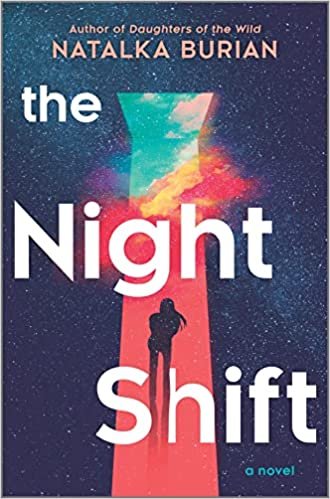
Natalka Burian On Writing The Night Shift & The Backrooms of the World

Inspiration is a funny thing. It can come to us like a lightning bolt, through the lyrics of a song, or in the fog of a dream. Ask any writer where their stories come from and you’ll get a myriad of answers, and in that vein I created the WHAT (What the Hell Are you Thinking?) interview. Always including in the WHAT is one random question to really dig down into the interviewees mind, and probably supply some illumination into my own as well.

Today’s guest for the WHAT is Natalka Burian, author of The Night Shift . Natalka is also the co-owner of two bars, Elsa and Ramona, as well as the co-founder of The Freya Project, a non-profit reading series that supports community-based activism and annually awards five unrestricted grants to further the work of women and non-binary writers.

Ideas for our books can come from just about anywhere, and sometimes even we can’t pinpoint exactly how or why. Did you have a specific origin point for your book?

 I love this question! The origin point for The Night Shift was actually a song: Destroyer’s Kaputt. There’s a line in the song that references the “back rooms of the world all night.” It sparked a conversation between me and my husband about being young in NYC and staying out way too late chasing down the next fascinating thing. We talked about how magical and mysterious those nighttime “back rooms of the world” could be. It was a time of life where anything seemed possible, even the existence of secret doors through space and time. From there, it was a pretty short jump to conceive of the shortcuts in The Night Shift .

 Once the original concept existed, how did you build a plot around it?

 Oh man, this absolutely was the hardest part. The concept was so fun and fantastic I wanted to make sure that the story could stand up to it. I knew the plot had to have some emotional grounding because the concept was so wild. Developing Jean, the protagonist’s, character really helped guide me to the right story. She is truly lost at the beginning of the book, and the plot sort of built itself around her personal emotional journey. It’s definitely not a coincidence that therapy plays such a substantial role in the plot.

Have you ever had the plot firmly in place, only to find it changing as the story moved from your mind to paper?
Always! In everything I’ve ever worked on, there is, inevitably, some drift from the original plan. In the Night Shift, though, it was less drift and more Rubik’s Cube. I’ve never written anything with time travel and I found that tweaks and shifts in the plot were essential to align everything that needed to be in alignment. It required constant plot flexibility and vigilance—honestly, I have never been more grateful to my editor or the proofers who worked on this book. Those extra pairs of eyes caught so many things that I missed!

 Do story ideas come to you often, or is fresh material hard to come by?

 Story ideas come to me a medium amount. I wish I was one of those people brimming with new ideas all of the time, but I’m also grateful I’m never sitting out there languishing and waiting for something exciting to begin. I find that every time I’m ready to start a new project, a compelling (usually only one!) idea is waiting.

 How do you choose which story to write next, if you’ve got more than one percolating?

 I almost always start with the idea that feels good, even if that idea is still on the vague side. I heard someone once say that you should write toward joy, that you should feel joy—or at the very least—pleasure when you’re developing an idea or writing toward something. So, I try to do that.

I have 6 cats and a Dalmatian (seriously, check my Instagram feed) and I usually have at least one or two snuggling with me when I write. Do you have a writing buddy, or do you find it distracting?

 You are living my dream life! I love cats so much (and living in NYC, I love even more that they are adorable and majestic insurance policies against rodent invasion.) Sadly, two of the people I live with are allergic to cats. But they aren’t allergic to dogs, which is great because I don’t know what I would do without our beloved, neurotic, sweet-tempered dog, Ruggles. I welcome writing buddies of all kinds—fortunately, I am not easily distracted!

Tess Gerritsen On Writing A Series & Pleasing Your Fans... Or Not

Today's guest is the internationally best-selling author Tess Gerrtisen whose 13th book in the Rizzoli & Isles Series, Listen to Me, releases this month. Tess joined me today to talk about writing such a beloved series for so long, keeping the characters real, and the balance between writing the story or pleasing your readers.

Listen to the Episode Now

Elizabeth Gould On Finding Our Mythical Selves in Modern Times

by ELIZABETH GOULD

Ever since I was a young girl, I’ve been captivated by the power of a good story. Once I learned to read, I happily immersed myself in fairytales, myths, and legends from around the world. As a devoted journal keeper who filled notebooks with poems, dreams, and fanciful musings, I discovered that writing was a magical act that used the ingredients of daily life to create a new world where wonder and beauty could coexist alongside trouble and heartbreak.

Throughout my school years, I was fascinated by the ancient cultures of Egypt, Greece, and Rome. Drawn to stories that featured goddesses and female divinities, I went on to study Art History at university, fusing my love for myth and history with visual storytelling.

In my twenties, I had the good fortune of spending a year traveling through Asia and the Indian subcontinent, immersing myself in the spiritual traditions of these lands. During my travels, I read Women Who Run With Wolves by Dr. Clarissa Pinkola Estes, Goddesses in Everywoman by Dr. Jean Shinoda Bolen, and She by Dr. Robert A. Johnson. These books set me on a path of exploring how feminine archetypes can provide a portal to access more profound levels of self-knowledge.

We all hold masculine and feminine energies within us. But our modern society, with its emphasis on power, control, and speed, is completely out of balance. I’ve often wondered what the world would look like if we called forth values and traits traditionally associated with the feminine - such as empathy, inclusion, and nurturance. How can I, as a modern woman living in a fast-paced world, resource myself from my inner knowing and from the dynamic rhythms of the natural world?

I thought a lot about this question as I wrote The Well of Truth , which was a creative project I set for myself while I was busy raising my family. Over several years, I slowly crafted these stories, embroidering on themes that were close to my heart. The book was completed during the pandemic, at a time when many of us have re-evaluated what it means to live an authentic, meaningful life.

The magical realism tales in The Well of Truth follow a female heroine named Grace through powerful moments in her adult life: getting married and divorced, raising children, going through menopause, losing loved ones, and ultimately making an independent life for herself. Through the trials and tribulations she faces, Grace receives guidance and mentoring from a diverse array of mythic figures. The Hindu goddess Kali, Yoruba orisha Yemanja, Egyptian priestess Nephthys, Tibetan deity Green Tara, and even the Celtic Green Man make cameo appearances in the stories. Although there’s a fantastical element to the mystical interactions, the stories are ultimately grounded in the exploration of a woman figuring out who she is and what she wants throughout her life.

Something special happens when transformational stories are shared. A space for healing is created which lifts us out of our mundane experiences and reminds us that we are not alone. My deepest hope is that the reflective waters of The Well of Truth will provide readers with a shimmering glimpse into a world of imaginative possibility in addition to offering refreshment for people of all ages, backgrounds, and creeds. More than ever, we need stories to help us remember our mythic selves so that we can meaningfully meet the challenges of our times.

ELIZABETH GOULD has long been fascinated with feminine archetypes, mythology, and rites of passage. She has taught and mentored girls at puberty and is the former director of a non-profit dedicated to positive menstrual/menopausal education and awareness. She holds a BA in Art History from Stanford University and an MS in Education from the State University of New York.

The themes in The Well of Truth grew organically out of her two decades of experience as a mother, teacher, and menstrual advocate. The stories incorporate her love of art, travel, mythology, goddess traditions, trees, storytelling, and the moon. The Well of Truth is her first book. For more information, please visit