Book Giveaway: Hot Reads For Summer's End!

IMG_1019.jpeg

Summer is getting away from us, and I have to admit I’m not terribly saddened by that. Fall has always been my favorite season, but I do dislike the way people refer to the upcoming school year as back to the books like that’s a bad thing.

Um…. I’ve been reading books all summer, thank you very much.

I thought I’d give away some of those books so that you can squeeze in a few more reads in the month of August!

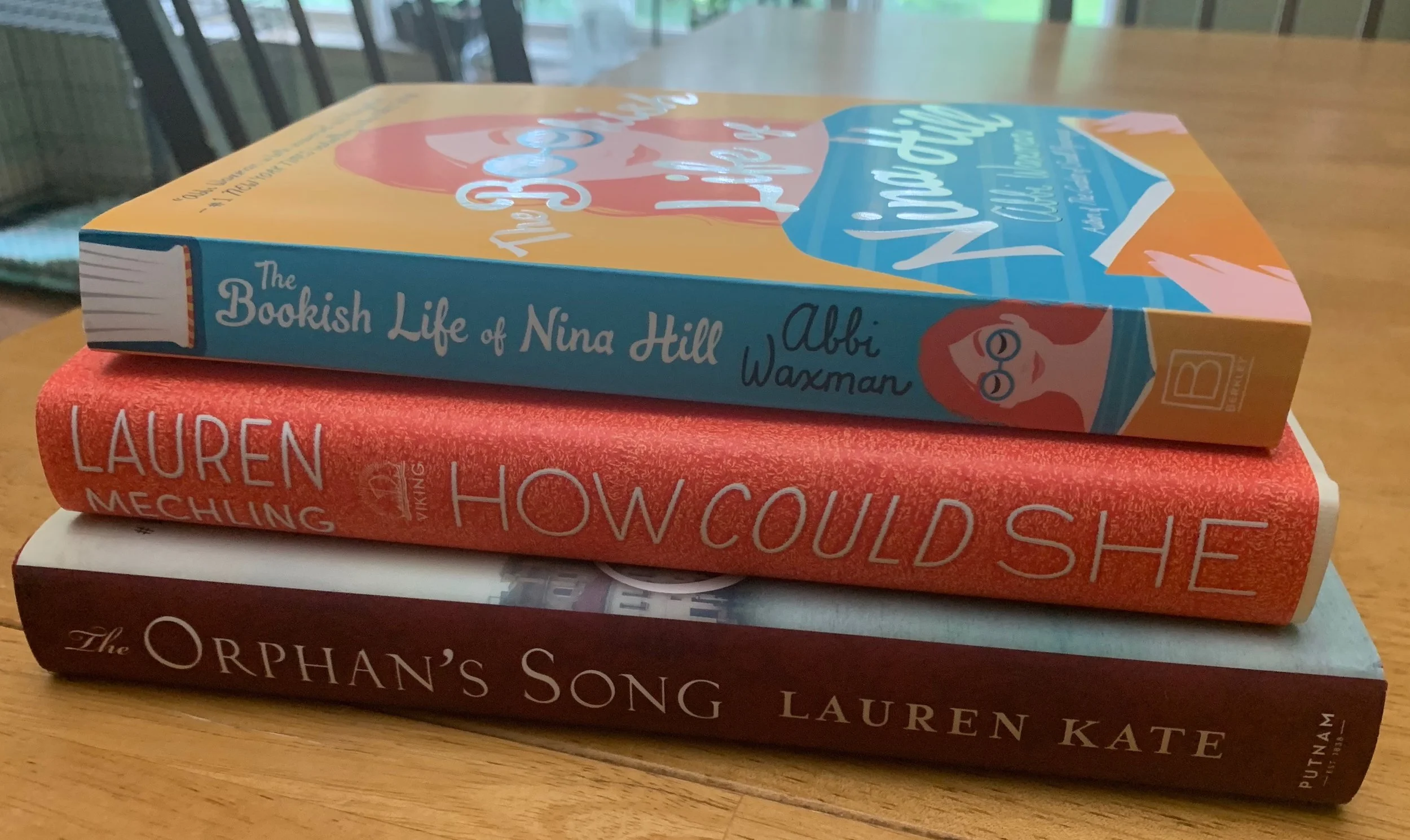
The Bookish Life of Nina Hill by Abbi Waxman: Delivers a quirky and charming novel chronicling the life of confirmed introvert Nina Hill as she does her best to fly under everyone's radar.

The only child of a single mother, Nina has her life just as she wants it: a job in a bookstore, a kick-butt trivia team, a world-class planner and a cat named Phil. If she sometimes suspects there might be more to life than reading, she just shrugs and picks up a new book.

When the father Nina never knew existed suddenly dies, leaving behind innumerable sisters, brothers, nieces, and nephews, Nina is horrified. They all live close by! They're all—or mostly all—excited to meet her! She'll have to Speak. To. Strangers. It's a disaster! And as if that wasn't enough, Tom, her trivia nemesis, has turned out to be cute, funny, and deeply interested in getting to know her. Doesn't he realize what a terrible idea that is?

Nina considers her options.
1. Completely change her name and appearance. (Too drastic, plus she likes her hair.)
2. Flee to a deserted island. (Hard pass, see: coffee).
3. Hide in a corner of her apartment and rock back and forth. (Already doing it.)

It's time for Nina to come out of her comfortable shell, but she isn't convinced real life could ever live up to fiction. It's going to take a brand-new family, a persistent suitor, and the combined effects of ice cream and trivia to make her turn her own fresh page.

How Could She? by Lauren Mechling: An assured and savagely funny novel about three old friends as they navigate careers, husbands, an ex-fiancé, new suitors, and, most importantly, their relationships with one another.

After a devastating break-up with her fiancé, Geraldine is struggling to get her life back on track in Toronto. Her two old friends, Sunny and Rachel, left ages ago for New York, where they've landed good jobs, handsome husbands, and unfairly glamorous lives (or at least so it appears to Geraldine). Sick of watching from the sidelines, Geraldine decides to force the universe to give her the big break she knows she deserves, and moves to New York City.

As she zigzags her way through the downtown art scene and rooftop party circuit, she discovers how hard it is to find her footing in a world of influencers and media darlings. Meanwhile, Sunny's life as an It Girl watercolorist is not nearly as charmed as it seemed to Geraldine from Toronto. And Rachel is trying to keep it together as a new mom, writer, and wife--how is it that she was more confident and successful at twenty-five than in her mid-thirties? Perhaps worst of all, why are Sunny and Rachel--who've always been suspicious of each other--suddenly hanging out without Geraldine?

Hilarious and fiercely observed, How Could She is an essential novel of female friendship, an insider's look into the cutthroat world of New York media--from print to podcasting--and a witty exploration of the ways we can and cannot escape our pasts.

Don’t miss my podcast episode with Lauren where she talks writing, publishing, and the crossroads of writing a novel set in the publishing world.

The Orphan’s Song by Lauren Kate: a sweeping love story about family and music--and the secrets each hold--that follows the intertwined fates of two Venetian orphans.

Venice, 1736. When fate brings Violetta and Mino together on the roof of the Hospital of the Incurables, they form a connection that will change their lives forever. Both are orphans at the Incurables, dreaming of escape. But when the resident Maestro notices Violetta's voice, she is selected for the Incurables' world famous coro, and must sign an oath never to sing beyond its church doors.

After a declaration of love ends in heartbreak, Mino flees the Incurables in search of his family. Known as the "city of masks," Venice is full of secrets, and Mino is certain one will lead to his long-lost mother. Without him, the walls close in on Violetta and she begins a dangerous and forbidden nightlife, hoping her voice can secure her freedom. But neither finds what they are looking for, until a haunting memory Violetta has suppressed since childhood leads them to a shocking confrontation.

Vibrant with the glamour and beauty of Venice at its zenith, The Orphan's Song takes us on a breathtaking journey of passion, heartbreak, and betrayal before it crescendos to an unforgettable ending, a celebration of the enduring nature and transformative power of love.

Don’t miss my podcast episode with Lauren where she talks about her research for The Orphan’s Song, plus writing for the YA market versus the adult market.

500 Queries In 6 Years: Wendy Heard

I'm lucky (or cunning) enough to have lured yet another successful writer over to my blog for an SAT - Successful Author Talk. SAT authors have conquered the query, slain the synopsis and attained the pinnacle of published. How'd they do it? Let's ask 'em!

Today’s guest for the SAT is Wendy Heard who was born in San Francisco but has lived most of her life in Los Angeles, which is on fire more than she would honestly prefer. She holds a Bachelor’s degree in Studio Art, emphasizing painting, and a Master’s degree in Education. Her debut, Hunting Annabelle, is out now. Her next book, The Kill Club, releases December 17, 2019.

Wendy is a member of Sisters in Crime, International Thriller Writers, and Mystery Writers of America, is a contributor at Crimereads.com, and co-hosts the Unlikeable Female Characters podcast.

Are you a Planner or Pantster? 

I have done it both ways. I started out as a pantser (no plot ensued), then over-plotted a book and lost all my interest in writing it. Now, I do an outline that thinks out all the major Save the Cat beats, but I only do detailed scene planning to the next plot point. Things change so much in the drafting process (something I thought would take 1 chapter takes 1 paragraph, something that I expected to take 1 paragraph takes a whole chapter, etc), so this leaves room for reflection without a bunch of re-planning. 

How long does it typically take you to write a novel, start to finish?

Before being published, I spent a year or two on each book. Now I do a first draft in 4-6 months because of this horrible thing called DEADLINES. So it’s 4-6 months of first draft, 4 months of developmental edits, and 4 months of copy and line edits and done! Usually. 

Do you work on one project at a time, or are you a multi-tasker?

I have come to the point where I can work on projects one right after the other, but I really try to keep only one on my desk at a time. Edit one, turn it in, draft another, turn it in, etc. If I’m in the middle of a draft and I get edits back, I’ll set the draft aside, bust out the edits, then return to the draft.

Did you have to overcome any fears that first time you sat down to write?

HAHAHAHA.

Yes.

I am one with all the fears.

So, first drafts suck. Characters don’t feel real = I will never get this character feeling real and I am a failure. Plot not working = I will never figure out how to fix this plot and I am a failure. Writer’s block = I will never be able to finish this book and I am a failure. Etc.

How many trunked books did you have before you were agented? 

Six fully completed and edited books were trunked along the way. 

Have you ever quit on an ms, and how did you know it was time?

Yes. I had a second book that just felt...wrong. I could tell this was the wrong book to follow up Hunting Annabelle. Based on that gut instinct, I shelved it halfway through and switched to what would ultimately be The Kill Club. It was a great decision. There’s nothing wrong with shelving a project that isn’t working, in my opinion.

Who is your agent and how did you get that "Yes!" out of them? 

Lauren Spieller with Triada US is my agent, and I absolutely love working with her. I cold queried her with Hunting Annabelle the traditional way, and she found me in her slush!

How long did you query before landing your agent? 

I queried four books over the course of my years in the trenches, totaling about 500 queries sent (way too many). I did a few R&Rs for agents (revise and resubmit). I am SO GLAD those projects didn’t sell. They were not ready. The whole process of querying was a start-and-stop one, but I believe it totaled about 6 years. 

Any advice to aspiring writers out there on conquering query hell? 

So many things I wish I could tell my former self, but the main one is: get comfortable throwing your words away. Write so much that it becomes less sacred. If a project doesn’t get picked up, be willing to move on. It’s not about THIS project, it’s about developing a strong portfolio of work and finding your voice and brand.

One more thing: Study back cover copy. Learn to write loglines and queries. Marketing copy is a huge part of the author gig. I did not know that.

How did it feel the first time you saw your book for sale?

Surreal. Terrifying. It’s public now. When someone buys it, it’s theirs. It’s not mine anymore. Strangely, once my debut was out in the world, I felt separated from it. Hunting Annabelle doesn’t feel as much mine as it used to. 

How much input do you have on cover art? 

It’s hard to say because I haven’t had to push back on anything. My cover designer, Kathleen Oudit with Harlequin, knocked it out of the park on both covers, so I don’t know what would happen if I did want to make major changes. They’ve been receptive to small adjustments, but honestly, I’ve been incredibly lucky. I’ve had a number of friends who pushed back quite a bit with their covers and gave detailed edits, and they were always listened to.

What's something you learned from the process that surprised you?

When you’re querying, you’re an entrepreneur. It’s hard to go from that mindset to working with a publishing house. You have to adjust your entrepreneurism to function within the bureaucracy because there is still a lot to do on your own as an author, but you have to do it in the right way and apply that energy to the right things. You have to learn when to wait and when to act; when to push back and when to hold your tongue; when to ask your agent for help and when to give them space; when to hold off on asking a question because you’re waiting on something else and when to go ahead and ask. It’s fraught with opportunities to fumble an interaction, and publishing is a small world where reputation is king. There is a lot to learn on the business and etiquette side of publishing, and finding mentor authors who are willing to help you navigate is key. I have been lucky to find successful, experienced authors who have been willing to message with me and help me understand things, and I hope to provide that same support to authors who are newer to this than I.

How much of your own marketing do you? 

I would say I am a mediocre marketer. I have social media (Twitter, Instagram, and Facebook). I do my own website and that has been really an important piece of the author thing. I study how other authors run their social media and sites and am always learning. Bookbub is something a lot of my friends are good at and I am not, but learning their ad platform seems quite smart and I plan to explore that this year. I make my own swag (I have an art degree) and I’m doing a preorder campaign for The Kill Club, which I didn’t do last time. I feel like I still have a lot to learn.

Heard.png

When do you build your platform? After an agent? Or should you be working before?

For me, social media has been for building community. So I started using Twitter long before working with my agent, just because I craved those relationships with other writers. I was lonely! But I also needed to learn about the business and culture of publishing, and Twitter in particular was great for that.

Do you think social media helps build your readership?

Maybe to an extent. But I’ve never tried to do this author thing without it, so I have no means of comparison. I think #Bookstagram on Instagram builds a lot of awareness with bloggers and reviewers,  but it’s important not to spam hashtags. But there’s no substitute for booksellers and Amazon algorithms, neither of which I can really control. For some people who have a large platform for other reasons (journalists, celebrities, athletes, etc), I’m sure their social media does help push sales. For normal Joes like me? Maybe a little.

All we can do is write the best books we can, be appreciative of those who help us (what goes around comes around and let us never forget it), and have professional, collaborative relationships with our editors, publicists, reviewers, friends, colleagues, readers… All we can do is our best, and the rest is just the rest.


Are We Having Fun Yet? Remembering Why You Write

I used to work in a public school. The two libraries I helped oversee served 5th graders through seniors, and I often ended up in the building way past the hours that I stopped getting paid. There's always something going on in a school, and basketballs bouncing in a gym have a way of calling to the ex-athlete, as does the ring of softballs hitting aluminum bats.

I don't get a chance to play much of anything anymore, taking the kayak out in the spring and hitting the gym three times a week is how I get my exercise now. But I'm often drawn into school sporting events, and while I know that the past is golden, I see some definite differences from the proverbial way things used to be.

I see the parents of fifth graders keeping stats in the bleachers, kids being pulled aside after games by coaches and parents alike (sometimes with a referee in tow for official backup) about what they did or didn't do, and how they can improve. I see adults talking about college admissions, scouts, percentages, injuries hurting playing time, and having conversations more suited to ESPN than a gym with fading paint.

Kid's faces are intense, and don't get me wrong - I think that's awesome. I know exactly how it goes in the moment, when a turnover under your hands feels like the end of the world, when sliding into home and winning the game could very well be the best thing that ever happened to you. Yeah, that's all true.

But sometimes I wonder if anyone out there is having fun anymore. Or anyone in the bleachers is either, for that matter.

Writing often feels the same way. I spent ten years receiving rejections for books that I was certain were Pulitzer material (they're not, for proof hit up my hashtag #BadFirstNovel). I was writing with visions in my head of awards, fame, and yes, money (that's a whole other post).

What I wasn't doing was writing because I loved it. I was writing because I was intent on making it my everything, and proving to myself and the world how freaking awesome I was.

  • Reality check #1 - I just wasn't.

  • Reality check #2 - That's partly because there was no heart in my writing.

After ten years of failing, I gave up. I truly did just let it go for a few years. I came back with a recharge and the thought that maybe I should try writing YA, since I had just started working in a high school. I came up with an idea I loved. A fun idea, nothing that was going to land me awards or even a sale, but something fun. Something I liked.

And I wrote it.

And while it didn't garner representation or achieve publication, I rediscovered the enjoyment of writing. Which prompted me to write Not A Drop to Drink, which opened up a whole new chapter of my life.

So if you're mired in your stats, or singing sad misereres over the dusty bones of the novel you've been rehashing forever, try to remember why you started doing this in the first place. And then maybe have some fun with it.